


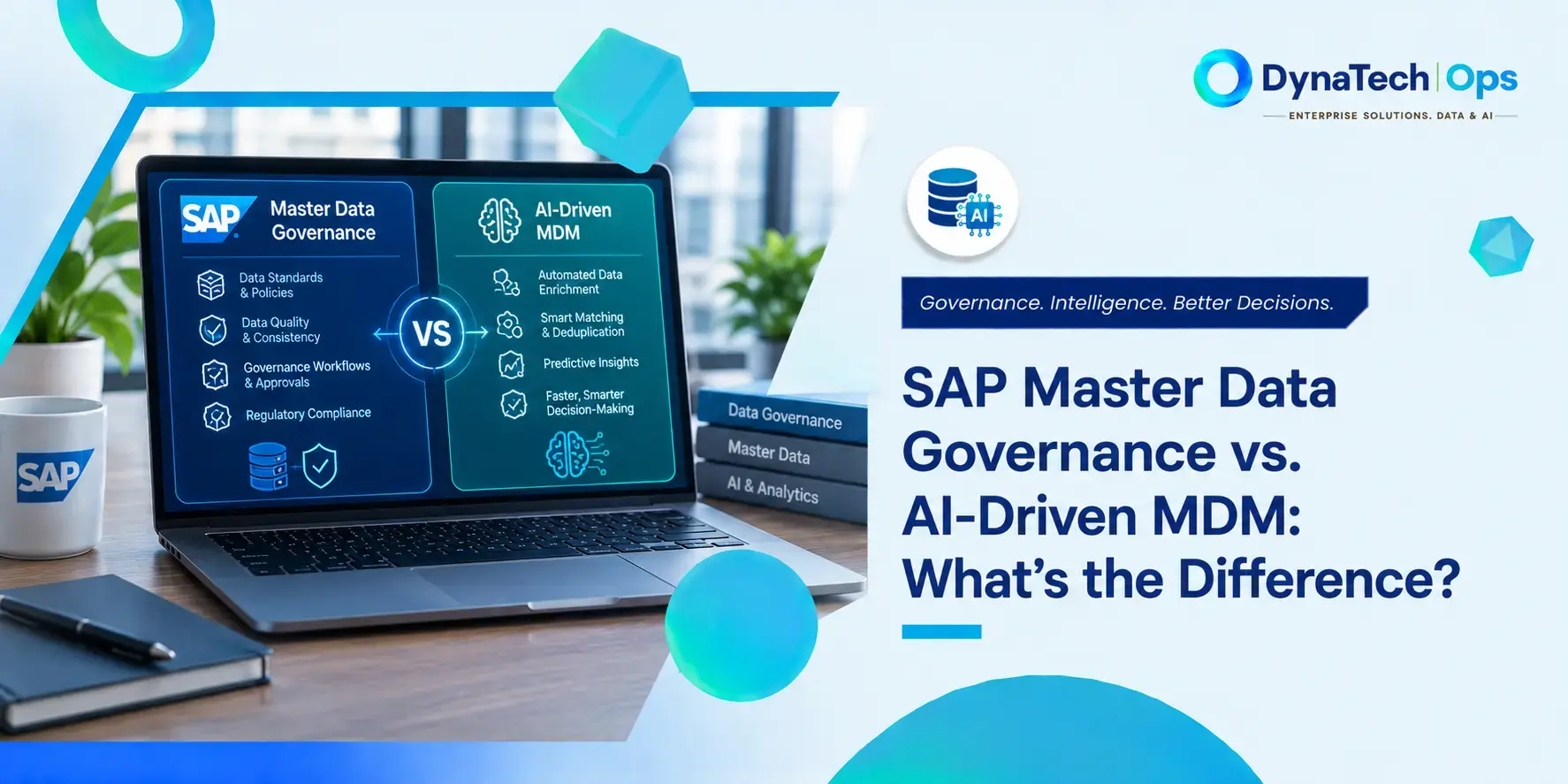
SAP Master Data Governance (MDG) is the governing body within the SAP environment that reviews and approves master data before it is used within standard SAP processes. An AI-based MDM platform also includes extensive cross-system discovery, matching, enrichment, and insights. In reality, an MDM platform with AI features rarely replaces SAP governance tools.
Key Takeaways
- SAP MDG vs AI-driven MDM is not just a comparison of competing tools. SAP MDG is centered on end-to-end governance for data creation and approval, whereas AI-enabled MDM can span systems for discovery, enrichment, and intelligent data management.
- Gartner research links unified semantic context with up to 80% higher agentic AI accuracy and lower costs, highlighting why trusted master data matters for AI initiatives.
- SAP MDG has some limitations for AI-heavy use cases, particularly around implementation effort, rule-based processes, and the speed at which data can be processed or changed.
- SAP is also adding AI capabilities to MDG. For example, AI-assisted change-request creation is available in certain cloud deployments, with current AI-driven features primarily associated with Private Cloud versions.
- The more useful comparison is often the AI MDM platform vs SAP MDG in terms of role, scope, and architecture rather than asking which platform is universally better.
The Real Question: Companion or Substitute?
The key question in SAP MDG vs AI-driven MDM is not which platform is better. It is whether they are designed to solve the same problem. SAP MDG is built to govern master data within the SAP environment, particularly where SAP is the system of record. AI-driven MDM can extend data management beyond core SAP processes by bringing together information from multiple systems and sources.
This distinction matters because enterprise master data rarely exists in one place. Customer, supplier, material, and product records may be spread across SAP and other business applications. SAP MDG can help control how records are created, validated, and approved within SAP, while an AI-driven MDM approach can provide a broader view of data across the organization.
The difference becomes even more important when organizations use AI for business decisions and automated workflows. AI systems depend on the quality and context of the data available to them. As Martin DuPont, Vice President of Product Marketing at Stibo Systems, explains:
“No matter how capable the model, it can only make decisions based on the data it is given” — and “one bad record can cascade through an entire AI agent workflow.”
Recent research into AI-ready data also highlights the value of unified semantics. Organizations that prioritize consistent meaning and context across their data could see up to 80% higher accuracy in agentic AI applications, alongside potential cost reductions. This reinforces why master data quality cannot be treated as a separate concern when building AI-driven workflows.
Therefore, the AI MDM platform vs SAP MDG discussion is better viewed in terms of roles rather than replacement. SAP MDG can remain the governance authority for core SAP master data, while AI-driven MDM can add capabilities such as cross-system matching, enrichment, relationship discovery, and intelligent data management.
The practical question is not simply whether to replace SAP MDG. It is whether the existing governance layer provides enough coverage for the organization's wider data landscape, data quality requirements, and AI use cases.
What SAP MDG Actually Does Well
SAP MDG’s biggest strength is bringing governance, data quality, workflow, and SAP business processes into one controlled framework. It supports core master data domains with standard data models, validation rules, approval of workflows, consolidation, duplicate detection, and replication capabilities.
For organizations that are heavily dependent on SAP, this native alignment can be especially valuable. MDG understands SAP data structures and business logic, allowing teams to govern records through defined change requests, approvals, validations, and activation processes rather than relying on separate processes around the SAP environment.
Where SAP MDG Provides Strong Value
- Centralized governance: Teams can define ownership, approval steps, authorizations, and business rules for creating or changing master data.
- Data quality controls: MDG supports validation and data quality checks to help prevent incorrect or incomplete records from entering business processes.
- Duplicate detection and consolidation: Master data from different sources can be standardized, matched, consolidated, and used to calculate a best record based on defined survivorship rules.
- Workflow and auditability: Change requests provide a structured process to review, approve, activate, and document master data changes.
- Replication: The Data Replication Framework can distribute governed master data to connected systems using defined replication models, filters, and mappings.
- SAP-native business logic: For SAP-centric organizations, MDG can apply SAP and organization-specific business rules directly within the governance process.
This makes SAP MDG particularly effective when the primary requirement is controlling creation and maintenance of trusted master data within an SAP-led landscape. It is not simply a database for storing records; it provides the processes required to decide what data should be created, who can approve it, how its quality is checked, and where the approved record should be distributed.
Where SAP MDG Genuinely Struggles for AI Use Cases
SAP MDG is effective for governed, SAP-centric master data, but its traditional architecture can create challenges for AI-driven use cases. The SAP master data governance limitations become more relevant when organizations need faster processing, more flexible matching, and data that can support real-time AI applications.
Peter Baumann’s March 2026 analysis highlights 12–24-month deployment cycles, steep learning curves, and significant customization requirements reported around SAP MDG. It also points to limitations in rule-based entity matching compared with machine learning approaches, along with batch-oriented processing that can create latency for real-time AI applications.
Key Challenges for AI Use Cases
- Implementation time: Extensive configuration and customization can slow down new AI initiatives.
- Rule-based matching: Traditional rules may struggle with complex or ambiguous records compared with machine learning-based matching.
- Processing latency: Batch-oriented processing may not suit applications requiring frequently refreshed or near-real-time master data.
- Customization effort: Broader, heterogeneous data environments can require additional development and integration of work.
The market also sends a notable signal. PeerSpot reported SAP MDG's mindshare in the Master Data Management software category at 7.9% in June 2026, down from 21.1% a year earlier. This is a market-engagement measure rather than a judgement on product quality, but the year-over-year change is significant.
The point is not that SAP MDG is unsuitable. Its governance, SAP integration, approvals, and auditability remain valuable. However, AI-heavy environments can demand capabilities such as real-time access, intelligent matching, cross-system context, and faster processing that may require additional capabilities beyond traditional MDG workflows.
What Dedicated AI-Driven MDM Platforms Add
Dedicated AI-driven MDM platforms are designed for environments where master data needs to be managed across multiple business systems, rather than primarily within SAP. ERP Research’s July 2026 analysis notes that multi-domain MDM becomes particularly relevant when organizations need to manage data across SAP and other enterprise applications.
This broader architecture can be useful when the same customer, product, or supplier data must remain consistent across different systems.
Where AI-Driven MDM Can Add Value
- Cross-system mastering: Manage master data across SAP, CRM, commerce, analytics, and other applications from a broader data layer.
- Intelligent matching: AI and machine learning can help identify duplicates and relationships that may be difficult to capture through fixed rules alone.
- Data enrichment: Combine information from multiple sources to create more complete and useful master records.
- Faster data processing: Modern architectures can support more frequent data updates for applications that need current information.
- AI-ready context: Connecting records across systems can give AI applications a more complete view of customers, products, suppliers, and their relationships.
For organizations where customer or product data must remain consistent across SAP and several other systems, a dedicated multi-domain MDM platform with strong SAP connectivity can be more practical than extending SAP MDG to govern every external system.
The distinction is therefore about architectural reach. SAP MDG provides deep governance within the SAP landscape, while AI-driven MDM can provide a wider layer for mastering and understanding data across the enterprise.
Where Traditional SAP MDG Approaches May Need Additional Capabilities
SAP MDG already provides important capabilities for governing master data. The question is not whether these capabilities have value, but whether they cover the requirements of a broader, increasingly connected data and AI environment.
Established SAP MDG Strengths
SAP MDG provides a structured foundation for:
- Governance and data ownership
- Master-data workflows
- Validation and data-quality controls
- Approvals and change requests
- SAP-centric business logic
- Auditability and controlled data changes
- Replication of governed data to connected systems
These capabilities remain relevant for organisations that need strong control over how master data is created, reviewed, approved, and maintained within an SAP-led environment.
Requirements That May Justify Complementary Capabilities
Some organizations may have requirements that extend beyond traditional SAP-centric governance, including:
- Cross-enterprise master-data management
- Heterogeneous data sources across SAP and non-SAP platforms
- AI-assisted matching and enrichment
- Broader semantic context across business systems
- More extensive relationship discovery
- New agentic AI use cases requiring governed access to connected master data
These requirements do not automatically mean SAP MDG needs to be replaced. They may instead indicate a need for complementary capabilities around the existing governance layer.
The distinction is important. MDG provides governance; additional MDM capabilities may extend how organisations discover, understand, enrich, and manage master data across a wider technology landscape.
SAP MDG and AI-Driven MDM: Key Differences
The differences become clearer when you compare SAP MDG and AI-driven MDM by architectural role, implementation approach, matching capabilities, and ideal use cases.
| Factor | SAP MDG | AI-Driven MDM Platforms |
| Architectural Role | Write-time governance authority embedded in SAP | Broader discovery and enrichment layer, often spanning multiple systems |
| Deployment Timeline | Typically, 12–24 months, depending on scope and complexity | Varies by platform and implementation; some vendors report 8–12 weeks per domain |
| Matching Approach | Primarily rule-based entity matching | Machine learning-based matching that can adapt to complex data patterns |
| Data Scope | Strong focus on governed master data within the SAP landscape | Designed to connect and manage master data across SAP and non-SAP systems |
| Best Fit | SAP-centric organizations with master data concentrated in SAP | Organizations where master data spans SAP, CRM, commerce, analytics, and other systems |
Note: Deployment timelines for AI-driven MDM depend on the platform and implementation. Figures such as 8–12 weeks per domain are vendor-reported and should not be treated as a universal benchmark.
How to Decide Between SAP MDG and AI-Driven MDM
The decision between SAP MDG and AI-driven MDM should start with the organization's data architecture and business requirements, not the technology label. Five questions can help determine whether SAP MDG is sufficient, whether complementary MDM capabilities are needed, or whether both approaches should work together.
1. Where Is Your Master Data Mastered?
If most critical master data is created, governed, and consumed within SAP, SAP MDG may provide the governance capabilities the organization needs.
For example, an SAP-centric environment where material, supplier, or business partner records primarily flow through SAP may benefit from MDG's native workflows, validation, approvals, and SAP business logic.
If master data is distributed across several platforms, the evaluation should also consider how those systems share and maintain common records.
2. How Heterogeneous Is the IT Estate?
The more systems involved, the more important cross-system data management becomes.
An organisation using SAP alongside CRM, ecommerce, commerce platforms, analytics tools, and external applications may need capabilities that extend beyond SAP-native governance.
In this situation, the key question is whether master data needs to be discovered, matched, enriched, and maintained across multiple systems rather than only governed within SAP.
3. What Problem Are You Solving?
Different data problems can require different capabilities.
Governance: If the primary need is controlling data creation, validation, approval, ownership, and auditability within SAP, MDG is closely aligned with the requirement.
Discovery, matching, and enrichment: If the organization needs to identify relationships across systems, detect complex duplicates, enrich records from multiple sources, or create a broader view of master data, complementary MDM capabilities may be worth evaluating.
The objective should be to match the technology to the data problem rather than introduce AI simply because it is available.
4. What AI Use Cases Are Planned?
AI requirements should be considered before selecting the data architecture.
An organization planning AI agents, predictive analytics, automated workflows, or intelligent recommendations should identify what data those applications will need and where that data currently resides.
Questions to consider include:
- Which master-data domains will AI applications use?
- Do AI workflows require data from multiple systems?
- How much context is needed to make reliable decisions?
- Which AI-assisted actions require human approval?
- What data-quality and governance controls are required?
This helps establish the required data context before deciding whether existing SAP governance capabilities are sufficient.
5. Can the Architectures Coexist?
In many enterprise environments, the decision does not have to be SAP MDG versus AI-driven MDM.
SAP MDG can remain the governance authority for SAP-native master data, while complementary MDM capabilities provide broader discovery, matching, enrichment, or cross-system data management.
This approach can allow organisations to build on existing SAP governance investments while addressing requirements that extend beyond the SAP landscape.
The final architecture should therefore reflect the organisation's systems, data domains, governance model, and AI roadmap. There is no universal requirement to replace SAP MDG simply because AI-driven MDM capabilities are being considered.
Frequently Asked Questions
1. Does SAP MDG need to be replaced by an AI-driven MDM platform?
No. SAP MDG can continue to serve as the governance authority for SAP-native master data. You may add an AI-driven MDM platform when you need broader cross-system data management, intelligent matching, or enrichment.
2. Can SAP MDG and a dedicated AI-driven MDM platform work together?
Yes. The two can serve different roles. MDG can manage governed creation and approval within SAP, while a broader MDM platform can provide cross-system discovery, matching, and enrichment.
3. Why does MDG's rule-based matching struggle with AI workloads?
Rule-based matching depends on predefined conditions and logic. AI workloads often involve complex, changing, or ambiguous data relationships. Machine learning-based matching can identify patterns across data that fixed rules may be missed.
4. Are SAP MDG's AI features available in on-premises environments?
Availability depends on the specific AI capability and SAP deployment model. Current AI-driven MDG capabilities are more closely associated with SAP's cloud deployments, particularly Private Cloud. Organizations should verify the availability of individual features against their specific SAP version and deployment model.
Related Terms
- AI MDM for SAP – Explore the broader market, use cases, and considerations shaping AI-driven master data management for SAP environments.
- AI MDM Glossary– Understand the core concepts behind AI-driven and agentic master data management.
- SAP Data, Analytics & AI Services– Explore how DynaTechOps help organizations approach SAP data, analytics, and AI initiatives.
Moving Beyond Traditional SAP Master Data Governance
Trying to decide between extending SAP MDG and adopting a dedicated AI-driven MDM platform? DynaTechOps can help assess the organization's SAP landscape, data architecture, and AI requirements to identify the approach that fits best.