


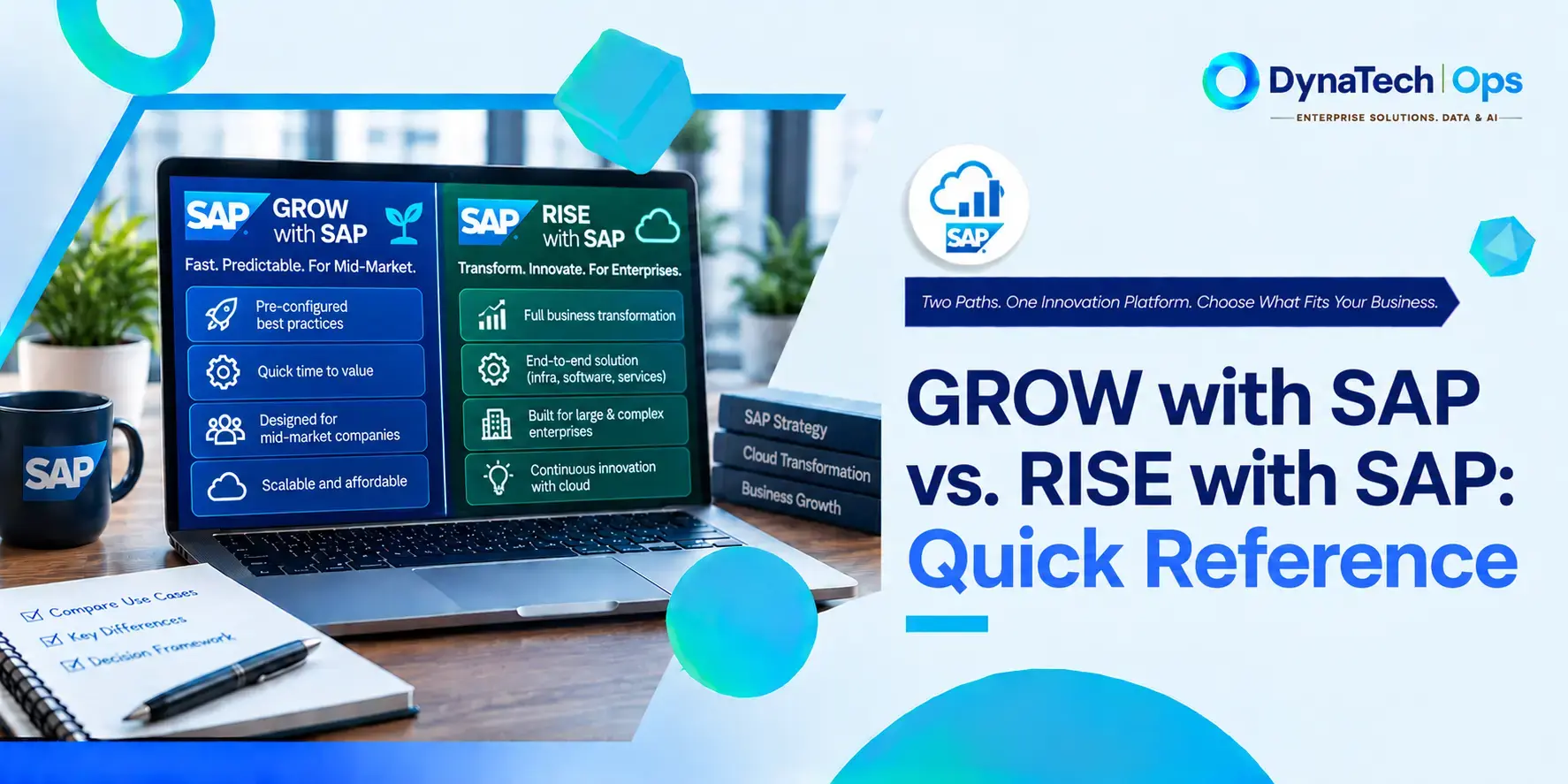
GROW with SAP is built for small and midsize businesses adopting cloud ERP for the first time, using SAP's public cloud ERP offering(now called SAP Cloud ERP) with minimal customisation. RISE with SAP targets organisations with more complex landscapes, often existing SAP customers, and is positioned around SAP's private cloud offering, now called SAP Cloud ERP Private, with far greater flexibility.
Key Takeaways
- GROW with SAP is designed for small and midsize businesses moving to SAP cloud ERP for the first time, using SAP's public cloud ERP offering.
- RISE with SAP is designed for organisations with complex, established landscapes, and SAP currently positions it around the private cloud offering.
- GROW relies on standardised best-practice processes with minimal customisation. RISE, on the private cloud offering, allows existing custom code and far greater flexibility.
- The deciding factor is not technical. It comes down to how closely the business can run to SAP's standard processes.
- Moving from GROW to RISE later is possible, but it requires a migration project rather than a routine upgrade.
SAP offers two cloud ERP programmes, and both include SAP's cloud ERP software. Both include access to SAP Business Technology Platform and are sold as subscriptions. That shared foundation is exactly why the GROW with SAP vs RISE with SAP choice confuses so many buyers.
RISE with SAP arrived in 2021 as a guided route to the cloud, largely for organisations already running SAP. GROW with SAP followed in 2023, aimed at midsize and growing businesses that wanted a ready-to-run cloud ERP without a long, complex set-up. The two programmes now sit side by side, and on the surface they can look almost interchangeable.
They are not. The difference comes down to how closely a business can work to SAP's standard processes, and that single question shapes the offering, the implementation approach, the contract and the long-term cost of ownership.
A note on terminology. SAP revised its cloud ERP naming in 2025. SAP S/4HANA Cloud Public Edition is now presented as SAP Cloud ERP, and SAP S/4HANA Cloud Private Edition as SAP Cloud ERP Private, both under the SAP Business Suite umbrella. GROW with SAP and RISE with SAP remain widely used terms for the two adoption paths, and SAP continues to use them, but packaging and product names have changed since the programmes launched. Anyone evaluating either option should confirm the current offerings, package names and inclusions directly with SAP or an SAP partner before making commercial decisions.
Quick Comparison
| GROW with SAP | RISE with SAP | |
| Built for | Small and midsize businesses new to SAP cloud ERP | Organisations with complex, established landscapes, often existing SAP customers |
| Cloud ERP offering | Public cloud only, now named SAP Cloud ERP | Primarily the private cloud offering, now named SAP Cloud ERP Private |
| Customisation level | Minimal, with standardised best-practice processes | High, with flexibility for complex requirements |
| Scope | ERP-focused implementation | Full business transformation, covering ERP plus process optimisation, analytics and collaboration tools |
The biggest difference isn't technical. It is about business complexity and customisation philosophy. GROW suits organisations that can adopt SAP's best-practice processes with minimal customisation. RISE suits organisations whose requirements need genuine flexibility.
What sits behind each row
Built for. GROW is typically a first cloud ERP for businesses moving away from spreadsheets, entry-level accounting software or older ERP platforms. It is also used by subsidiaries of larger groups that need their own ERP environment while staying connected to the parent organisation. RISE is the common route for organisations running SAP ECC or other established ERP systems, though it is not limited to existing SAP customers.
Cloud ERP offering. The public cloud offering is a multi-tenant SaaS system. SAP manages the infrastructure, security and updates, and every customer runs on the latest release. The private cloud offering, which SAP positions with RISE, is a single-tenant environment where the customer keeps more control, including over custom code and the timing of upgrades.
Customisation level. On the public cloud offering, businesses configure within SAP's boundaries and extend through SAP BTP and key user tools, but they cannot modify the core application code. The private cloud offering provides significantly more room for customisation, integration complexity and industry-specific processes, although SAP's Clean Core principles still apply to how those extensions should be built.
Scope. GROW centres on getting a standardised cloud ERP running quickly. RISE is positioned as a broader transformation, which generally means a longer project because of the added work in landscape design, data migration, integration and custom development.
One further practical difference follows from these rows:
Implementation approach: GROW is generally positioned around a new, standardised implementation rather than carrying legacy configuration across. RISE supports both new implementations and conversions of existing systems, so an established system can be converted or rebuilt. Confirm the available approaches for your situation with SAP or your implementation partner.
Innovation cadence: GROW customers receive new capabilities, including SAP's embedded AI features, automatically through the public cloud release cycle. Private cloud customers manage upgrades on their own schedule, which gives them more control but also means adopting new features is a deliberate decision.
The Most Important Question
If your organisation can run its core processes close to SAP's standard, best-practice model with minimal customisation, GROW is very likely the right fit. If your business has genuinely complex, non-standard requirements that need real flexibility, RISE is the more realistic path.
Company size and SAP history are useful signals, but neither settles the question. A long-standing SAP customer can still be a good fit for GROW if much of its custom code no longer serves a real purpose. A relatively small business can still need RISE if it operates in a highly regulated industry or depends on processes that genuinely set it apart from competitors.
A few questions help make the decision concrete:
Which processes genuinely differentiate the business? Only those processes justify departing from SAP's standard. Everything else is usually better adopted as delivered.
How much existing custom code is still in active use? Legacy customisations are often assumed to be essential, but many turn out to be technical debt that a standardised process would replace.
How much control over upgrades does the business need? Some organisations are comfortable taking SAP's release cycle as it comes. Others need to schedule change around their own operational calendar.
What do regulatory and data requirements demand? Strict compliance or data-control requirements can point to a private cloud environment.
Where will the business be in five years? A company expecting rapid growth in scale or complexity should weigh whether standard processes will still fit, or whether a later migration is likely.
Getting the GROW with SAP vs RISE with SAP decision right matters more than it might seem, because the programme shapes cost, flexibility and effort for years afterwards. A fit-gap analysis during the early stages of evaluation gives the decision a factual basis rather than leaving it to assumptions about how standard or unusual the business really is.
Want the Deeper Comparison?
For a more detailed side-by-side comparison, including SuccessFactors and other SAP solutions, see the Solutions Hub.
Frequently Asked Questions
1. Can a business switch from GROW with SAP to RISE with SAP later?
Yes, but it is not a routine upgrade. Moving from the public cloud offering to a private cloud environment requires its own migration project, covering data transfer and implementation, so it is worth choosing with future complexity in mind.
2. Does RISE with SAP cost more than GROW with SAP?
Generally, yes. RISE projects, particularly those on the private cloud offering, typically cost more because they include additional migration, integration, and customisation work. Neither programme has a published list price, and pricing is negotiated case by case. Contract terms also differ, and you should confirm commitment periods with SAP or your partner, since packaging has changed since 2025.
3. Do GROW and RISE use the same licensing model?
Both are priced on Full Use Equivalents (FUEs), which weight users by how they use the system. One advanced user counts as one FUE, five core users count as one FUE, and thirty self-service users count as one FUE. Accurate user classification is therefore one of the biggest cost levers in either programme. FUE ratios are published by SAP, but the packages they apply to were revised in 2025, so confirm the current commercial terms before budgeting.
4. What is the main difference between SAP GROW and RISE with SAP?
The GROW with SAP vs RISE with SAP decision comes down to how closely a business can run on SAP’s standard processes. GROW delivers a preconfigured public cloud ERP with minimal customisation, so adoption is faster but processes have to follow the standard model. RISE supports complex, established landscapes where genuine flexibility is needed, and it treats the move as a wider business transformation rather than an ERP installation.
5. Is SAP GROW only for small businesses?
No. It is aimed at midsize and growing businesses, and it is also used by subsidiaries of larger groups that need their own ERP environment while staying connected to the parent organisation. The deciding factor is process complexity rather than headcount or turnover. A large business running genuinely standard processes can be a good fit, while a smaller one with heavily specialised operations may not be.
6. Is RISE with SAP only for existing SAP customers?
No, though that is where most RISE projects come from. Organisations running SAP ECC or another established ERP commonly use RISE to move to cloud ERP while carrying forward existing configuration and history. New customers can also choose RISE when their requirements call for a level of flexibility the public cloud offering does not allow.
7. Does SAP GROW use public or private cloud ERP?
GROW uses the public cloud offering, which SAP now presents as SAP Cloud ERP. It is a multi-tenant SaaS environment, so SAP manages the infrastructure and applies updates on a fixed release cycle that all customers follow. RISE is primarily associated with the private cloud offering, now named SAP Cloud ERP Private, where the tenant is dedicated and upgrade timing is more flexible.
8. Can you move from SAP GROW to RISE with SAP?
Yes, but it is a migration project rather than a routine upgrade. Data has to be transferred, and extensions built for the public cloud need to be reassessed against the private cloud extensibility model. Because the effort is comparable to a fresh implementation, future complexity is worth weighing at the point of first choosing, not after go-live.
9. How does Clean Core affect GROW vs RISE?
In GROW, Clean Core is enforced by the platform. Modifying the core is not possible, so extensions are built with released APIs, key user tooling and side-by-side development on SAP Business Technology Platform. In RISE, the private cloud still permits classic developments in the core, which means Clean Core becomes a discipline the organisation has to choose and govern. Teams that hold to it keep upgrades considerably simpler.
10. Which offers more customisation, SAP GROW or RISE with SAP?
RISE, by a clear margin. The private cloud offering supports deeper extensibility, including custom developments that sit closer to the core, which suits regulated or highly specialised operations. GROW restricts customisation deliberately, and that restriction is what allows a shorter implementation and a lighter upgrade path. More customisation also means more to test and maintain over time.
11. How do SAP GROW and RISE differ in implementation approach?
Both follow the SAP Activate methodology, but the work inside it differs. GROW begins from preconfigured best-practice content and runs fit-to-standard workshops, where the question is how the business adapts to the standard process. RISE typically involves fit-gap analysis, a system conversion or a greenfield build, and process redesign across a longer programme with several phases.
Related Terms
For the full comparison across SAP's solution portfolio, see the Solutions Hub. For what to consider before committing to a long-term RISE contract, see our RISE with SAP Exit Strategy guide. To understand how we identify process gaps before choosing a programme, see our Fit-Gap Analysis glossary entry.
Not Sure Which Programme Fits?
The right choice depends on how your business actually runs, not on which package sounds bigger. Talk to DynaTech Ops about assessing your processes against SAP's standard model before you commit.