


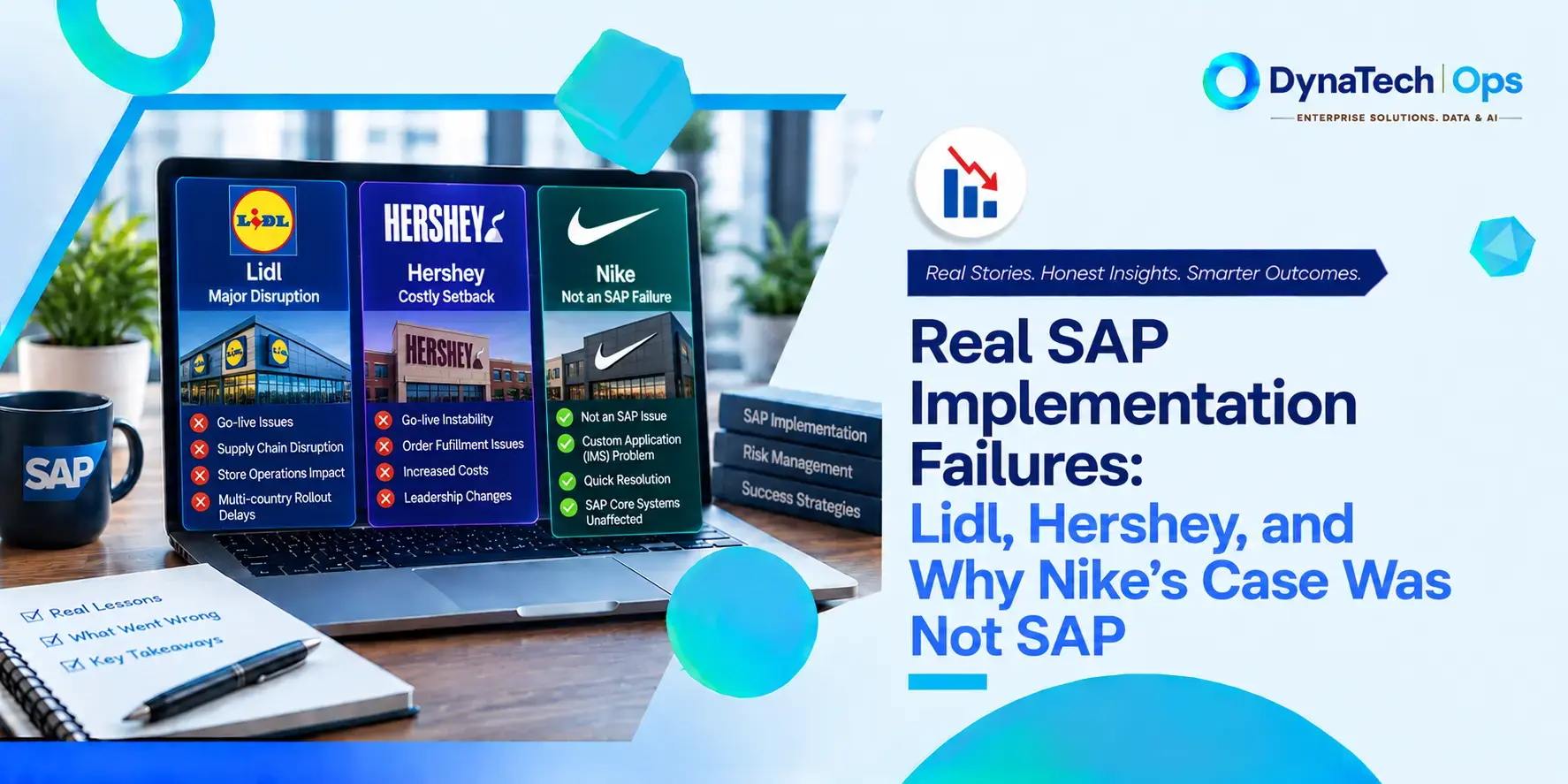
In 2018, Lidl abandoned its €500 million SAP program after seven years. In 1999, Hershey’s implementation of an enterprise system led to more than $100 million in unfilled orders. Their situations were different, but both show how decisions about process, implementation planning, testing, and go-live readiness can materially affect an ERP outcome.
Key Takeaways
- Lidl abandoned its SAP implementation in 2018 after seven years and approximately €500 million invested, reverting to its legacy inventory management system.
- Published case-study analyses attribute the outcome to a process mismatch. Lidl's inventory system was built on purchase prices, while SAP's standard retail model is built on retail prices, and Lidl chose to customise SAP around its existing workflow rather than change those processes.
- Hershey's 1999 simultaneous go-live of SAP, Manugistics and Siebel was compressed from a recommended 48-month timeline to 30 months to beat Y2K. It went live in July, just ahead of the Halloween and holiday rush, and reported figures point to more than $100 million in unfilled orders and a 19% drop in quarterly profit.
- Nike's widely cited 2000 supply-chain disaster is frequently miscategorised as an SAP failure. It was tied to a demand-planning system from i2 Technologies, a separate vendor. SAP was not the platform involved, and the case is included here specifically to correct that misconception.
- The three cases differ in vendor, scale and outcome. Read together, they point to recurring themes worth planning around: process fit, timeline pressure, testing depth and go-live readiness.
When an ERP project collapses, the software usually takes the blame. The vendor's name appears in the headline, and the story settles into a simple shape: the system did not work.
The documented record tells a different story. Every serious SAP implementation failure case study points back to decisions made long before go-live: how much to customise, how much time to allow, how much to test, and when to switch over. Lidl and Hershey are two of the most expensive examples. Nike is a third name that often appears alongside them, though its case involved a different vendor entirely. Looking at what actually happened in each one is the most reliable way to avoid repeating it.
Lidl: The €500 Million Lesson in Customisation Risk
Few projects illustrate the cost of customisation as clearly as the Lidl SAP failure.
In 2011, the German discount grocer launched a project internally called eLWIS, short for electronic Lidl merchandise management and information system. Thousands of staff and hundreds of outside consultants worked on it, aiming to replace Lidl's homegrown merchandise management with a single SAP platform.
The documented sticking point surfaced early. Lidl had always valued its inventory at purchase prices, while SAP's standard retail model is built around retail prices. Published analyses of the project describe the decision that followed as pivotal: rather than align its valuation approach with the standard model, Lidl customised SAP to preserve its existing approach.
Meanwhile, the same analysis blames the cost and timeline overruns on the level of customisation required by that decision, noting that each modification adds complexity and makes the next one harder. Reports also say executive turnover during the project's seven-year life coincided with shifting priorities.
Perhaps the most striking detail is the timing. SAP recognised Lidl as one of its top customers in 2017. A year later, Lidl abandoned the entire project, wrote off roughly €500 million (about $580 million), and returned to its original inventory management system.
What the case documents is not a software defect but a process-fit decision made early and compounded over several years.
Hershey: What Happens When You Rush a Go-Live Before Peak Season
The Hershey SAP implementation failure is a story about timing and testing more than technology.
In late 1996, Hershey approved a $112 million modernisation programme called Enterprise 21. It would replace legacy systems with three platforms: SAP R/3 for ERP, Manugistics for supply chain planning, and Siebel for customer relationship management.
The recommended implementation timeline was 48 months. Hershey compressed it to 30 months so the new systems would be live before Y2K. Published case studies of the project record that testing phases were shortened as a result.
The cutover came in July 1999, which was exactly the wrong moment. Late summer is when Hershey receives the bulk of its Halloween and holiday orders, its most important selling period of the year. The three systems did not work together as intended, and orders stopped flowing through the business properly.
Reported figures put the shortfall at more than $100 million in orders Hershey could not fulfil, even with product in its warehouses. Third-quarter profit fell 19%, and sales fell 12%, with competitors including Mars and Nestlé taking shelf space Hershey could not fill.
Hershey recovered and stayed with SAP. Its upgrade to SAP R/3 4.6, which ran from July 2001 to May 2002, came in 20% under budget without any of the order and shipping disruption of 1999. The contrast between the two projects is usually attributed to the planning and testing time allowed for each.
Nike: The Failure Often Wrongly Blamed on SAP
Many ERP failure listicles group Nike alongside Lidl and Hershey. That grouping is inaccurate, and it is worth stating plainly before anything else: Nike's 2000 disruption was not an SAP implementation failure.
The so-called Nike SAP failure: i2 Technologies, not SAP, supplied the software at the centre of it. In 2000, Nike deployed a demand-planning system from i2 Technologies, a separate vendor, as part of a broader supply-chain transformation. The system produced inaccurate demand signals, leading Nike to over-order slower-selling shoes and under-order popular models.
Reported estimates put the resulting inventory mismatch at about $100 million in lost sales, with a share price plummeting around 20% and class-action lawsuits from investors.
That doesn't make it a SAP case. This correction is important for anyone researching SAP risk. Repeating the mistake muddies the issue of what is a problem limited to one platform and what is a problem common to any large system rollout. If an article lists Nike as a SAP failure, then their other claims should be viewed with suspicion.
The Nike lesson still applies, but more broadly. Complex, tightly coupled system integrations from any vendor pose real risk if they go live without sufficient testing and a phased rollout plan.
Comparison Table: Documented Facts and Implementation Lessons
| Company | System / Vendor | What Happened | Reported Business Impact | Key Implementation Lesson (DynaTech Ops view) |
|
Lidl (2018) |
SAP |
Programme abandoned after seven years; reverted to legacy system |
~€500M (~$580M) investment written off |
Process fit and customisation scope |
|
Hershey (1999) |
SAP + Manugistics + Siebel |
Fulfilment disruption after a compressed, simultaneous go-live |
$100M+ in unfilled orders; 19% fall in quarterly profit |
Testing and cutover readiness |
|
Nike (2000) |
i2 Technologies, within a broader transformation. Not SAP |
Demand-planning problems produced inaccurate forecasts |
~$100M impact reported; share price fall of roughly 20% |
Planning, integration and testing depth |
Recurring Themes Across the Three Cases
The three projects involved different vendors, different decades and different outcomes, so they are not variations of a single failure. Read alongside the wider body of documented ERP case studies, however, a few themes recur often enough to be worth planning around.
Deadlines set by the calendar rather than readiness. Y2K drove Hershey's schedule, and a target date rather than system readiness decided the go-live.
Software customised to preserve existing processes. Lidl's decision to retain purchase-price valuation is the documented example, and the customisation it required is what published analyses point to as the project's central difficulty.
Testing compressed to protect a date. Hershey's shortened testing phases meant integration problems surfaced in production rather than in a test environment.
No safety margin before peak periods. Going live just ahead of the busiest season left no room to absorb problems.
None of these describes a software defect. Each is a planning or governance decision made before go-live, which is why it's worth examining before a project starts rather than after.
How to Actually Avoid This
Each recommendation below maps to the case that demonstrates why it matters.
Run a real fit-gap analysis before committing to custom development (Lidl). Map where your processes differ from the standard model, and decide deliberately which gaps justify customisation and which call for process change. Lidl's case shows how a single early valuation decision can define a seven-year programme.
Keep go-live away from peak business periods (Hershey). Schedule cutover when the business can absorb disruption, not when volume is highest. Hershey went live in July, weeks before its Halloween and holiday order peak.
Resist compressing timelines for external deadlines (Hershey). If a date is not tied to actual readiness, treat it as a constraint to negotiate rather than a target to hit at any cost. Hershey's 48-month plan became 30 months to meet Y2K.
Fund testing and change management properly (Hershey and Nike). Integration testing at realistic volumes deserves the same investment as the technical build. Hershey's shortened testing and Nike's demand-planning rollout both surfaced production problems.
Set go/no-go criteria in advance (all three). Agree the conditions for go-live early, so the decision rests on evidence rather than on the calendar.
For more on getting these decisions right, see How to Choose the Right SAP Implementation Partner and our Fit-Gap Analysis glossary entry.
Frequently Asked Questions
1. Was Nike's 2000 supply-chain failure actually an SAP implementation failure?
No. Nike's 2000 disruption was tied to a demand-planning system from i2 Technologies, a separate vendor. People often mistake it for an SAP failure, but SAP wasn't the platform involved.
2. Why did Lidl abandon its SAP implementation after seven years?
Lidl valued inventory at purchase prices, while SAP's standard model uses retail prices. Rather than change those processes, Lidl customised SAP extensively, and published analyses attribute the project's rising complexity and cost to the scale of that customisation. Lidl abandoned the project in 2018 at a reported loss of about €500 million. The Lidl SAP failure remains the clearest example of customisation risk.
3. How much did Hershey lose in its 1999 SAP go-live failure?
Reported figures put the shortfall at more than $100 million in unfilled orders, with third-quarter profit falling 19%. The Hershey SAP implementation failure also cost it shelf space to competitors during its most important selling season.
The single most common root cause of top ERP implementation failures is:
The most common reasons cited in published case studies are planning and governance decisions rather than software defects, such as tight deadlines, inadequate testing, and modifying the software to keep existing processes instead of adapting to the platform’s standard model.
If you are weighing up who should lead your project, start with our guide on How to Choose the Right SAP Implementation Partner. To understand how process gaps are identified before any build begins, see our Fit-Gap Analysis glossary entry. For support planning your own rollout, explore our SAP Implementation & Rollout services.
Planning an SAP Implementation? Start With a Realistic Plan
Planning an SAP implementation and want to avoid becoming the next case study? Talk to DynaTech Ops about assessing fit gaps, setting go-live timing around your trading calendar, and building testing into the plan from the start.