.png)


.svg "DynaTechOps")
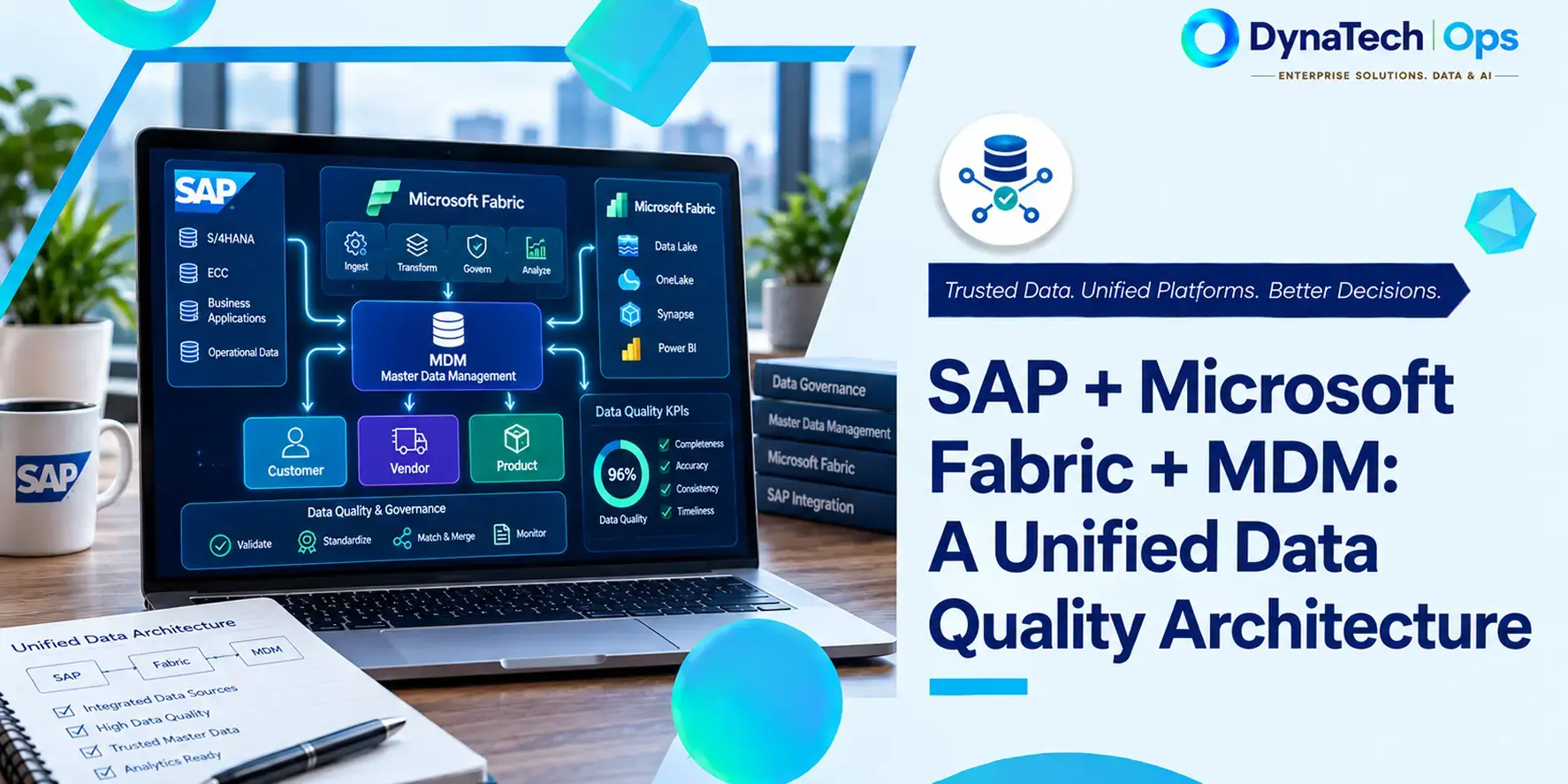
In a unified SAP and Microsoft Fabric architecture, MDM and Fabric serve different but complementary roles. MDM creates governed, deduplicated, and unified master records, while Fabric's OneLake brings broader enterprise data together for analytics and AI. Not every source need MDM; use it where entity unification and trusted master data add clear value.
Key Takeaways
- Not every data source in a Fabric architecture needs to pass through MDM. MDM should focus on critical entities where deduplication, standardization, and unification matter most.
- SAP and Fabric can bring operational and analytical data closer together, making master data quality Microsoft Fabric architecture an important consideration before data reaches downstream analytics and AI use cases.
- Microsoft Fabric provides a broader data platform, while MDM provides the governed master-data layer needed for consistent customer, product, supplier, and other business entities.
- Clean master data becomes especially important when AI applications need to connect information across customers, products, transactions, and other business domains.
- The goal of an SAP fabric MDM architecture is not to put every dataset through MDM. It is to place data-quality controls where they create the most business value.
Not Everything Needs to Pass Through MDM
Not every dataset in an SAP fabric MDM architecture needs to pass through MDM. Treating MDM as a mandatory layer for every source can add unnecessary complexity. A more practical approach is to identify which data domains need stronger controls for identity, consistency, and quality.
Some data can be reconciled and integrated directly within Microsoft Fabric, while MDM can focus on the areas where it provides the most value. This includes creating trusted golden records through deduplication, data quality rules, standardization, and entity unification.
In practice, MDM is most useful for business entities where duplicate, conflicting, or incomplete records can affect downstream reporting, analytics, and AI applications. Common examples include customer, product, supplier, and location data.
This creates a clear separation between broader data integration and master data management:
| Requirement | Primary role |
| Bringing data from different sources together | Microsoft Fabric |
| Combining operational and analytical datasets | Microsoft Fabric |
| Deduplicating customer or product records | MDM |
| Creating trusted golden records | MDM |
| Standardizing critical business entities | MDM |
| Applying master data governance | MDM |
| Combining trusted master data with broader enterprise data | MDM + Fabric |
This targeted approach supports better master data quality Microsoft Fabric architecture. Fabric can provide a broader environment for integrating and analyzing enterprise data, while MDM applies deeper quality controls to the entities where consistency matters most.
The objective is not to make MDM a checkpoint that every dataset must cross. It is to place master data controls where they solve a genuine business problem, while allowing other data to move through the Fabric environment without unnecessary processing.
When You Don't Need MDM
MDM is not automatically required for every dataset in an SAP and Microsoft Fabric architecture. The need for a dedicated MDM layer depends on the type of data, the business problem, and how that data is governed across systems.
You May Not Need a Dedicated MDM Layer When:
- The dataset isn't master data: Transactional, log, event, or other analytical datasets may not require master-data management.
- Entity deduplication isn't required: If records are already unique and duplicate entities do not create business problems, additional mastering may add unnecessary complexity.
- A trusted master already exists: If an authoritative source already maintains consistent customer, product, supplier, or other master records, another MDM layer may not be necessary.
- The use case is purely analytical: Some reporting and analytical workloads can use data directly within Microsoft Fabric without creating or maintaining new golden records.
- Source-system governance is sufficient: If the source system has effective validation, ownership, workflows, and data-quality controls for a specific scenario, those controls may be enough.
Consider MDM When:
- Entities differ across systems: The same customer, supplier, product, or other business entity appears differently across SAP and non-SAP platforms.
- Duplicates affect business processes: Duplicate or conflicting records create problems in sales, procurement, reporting, fulfilment, service, or other operations.
- Stewardship and governance are required: Data needs defined ownership, approval workflows, quality rules, or ongoing stewardship.
- Authoritative identity is unclear: Multiple systems contain records for the same entity, but there is no clear source of truth.
- AI needs consistent entity context: AI applications need to connect customers, products, suppliers, transactions, and related information reliably across systems.
The decision should therefore start with the data problem rather than technology. If existing systems already provide the required level of identity, quality, and governance, adding MDM may not provide enough additional value. Where business entities are fragmented, duplicated, or difficult to govern across systems, MDM can provide a stronger foundation before that data is used in Fabric analytics and AI workloads.
Why Master Data Quality Has to Happen Before the Fabric Layer, Not After
Consider an AI shopping assistant handling a simple customer request: reorder a previously purchased product in a different color and have it delivered to the customer’s home. On the surface, this looks like a straightforward AI query. Completing it correctly requires several connected pieces of master data.
The assistant needs to identify the correct customer and their purchase history, find the right product available in color or size, retrieve the correct shipping address, and use the relevant payment preferences. If these records are duplicated, outdated, or inconsistent across systems, the AI may not have enough reliable information to complete the request accurately.
This is where master data quality Microsoft Fabric architecture becomes important. Fabric can bring data together for analytics and AI, but it does not automatically resolve every underlying master data problem. MDM helps establish consistent, trusted records before downstream applications use that information.
The same principle applies to SAP data. Microsoft’s technical guidance explains that SAP Business Data Cloud Connect for Fabric can reduce reliance on batch-oriented extraction pipelines and the latency involved in synchronizing transactional and analytical environments.
That creates an important architectural distinction: faster data movement does not automatically mean better data. If customer, product, supplier, or other critical master records are inconsistent, a low-latency architecture can simply make inaccurate information available to analytics and AI applications faster.
A reliable SAP Fabric MDM architecture therefore addresses data quality before it becomes a downstream problem. MDM establishes consistency for the master data that needs it, while Fabric can use trusted information alongside other enterprise data for reporting, analytics, and AI use cases.
The Real Performance Numbers Behind This Architecture
Evaluate an SAP Fabric MDM architecture on measurable outcomes, not just the promise of a unified data environment. Published Microsoft benchmarks cited in December 2025 provide some useful reference points for SAP-to-Fabric integration:
- Up to 40% reduction in development time when using pre-configured SAP connectors.
- Up to 2 million SAP records are processed per hour through batch extraction.
- Up to 65% faster reporting cycles when SAP data is enriched with information from CRM and finance systems.
These figures help technical decisionmakers understand the potential impact of a connected architecture. However, treat them as benchmarks rather than guaranteed results. Actual performance will depend on factors such as data volumes, transformation requirements, source-system configuration, network conditions, and the specific workload.
This architecture's key point is that data movement and master data quality address different problems. Faster integration reduces latency but doesn't fix duplicate customers, inconsistent product records, or conflicting supplier data, which require proper MDM processes.
A Practical Reference Architecture
A practical architecture connects business systems, master-data governance, data access, and analytics. The exact pattern depends on where master data is mastered and governed, which may vary across organizations and data domains.
Business systems -
SAP + CRM + commerce + other platforms
↓
Master-data governance/mastering
↓
SAP/Fabric data-access and integration patterns
↓
Microsoft Fabric / OneLake
↓
Power BI / Analytics / AI
At the first layer, business systems create and use customer, supplier, product and other critical business data. These systems may include SAP applications, CRM platforms, commerce systems and other enterprise applications.
The master-data governance or mastering layer helps establish consistent and trusted records for critical entities where deduplication, standardization, enrichment or entity unification is important. This could involve SAP MDG, a dedicated MDM platform or a combination of capabilities, depending on the organization's architecture and governance model.
The next layer covers the data-access and integration patterns used to move or expose data between SAP, Microsoft Fabric, and other parts of the data environment. SAP Business Data Cloud Connect can be part of this architecture by making SAP data available in Microsoft OneLake and supporting access without relying solely on traditional batch-oriented extraction pipelines.
Microsoft Fabric and OneLake then provide a broader environment where SAP and non-SAP data can be brought together for analytics, business intelligence and AI workloads. Power BI and other analytical or AI applications can consume this data to support reporting, analysis and business use cases.
This separation matters because MDM does not need to become another general-purpose data integration layer. Its role is to maintain the quality, consistency, and governance of critical business entities. The broader data platform can then combine those trusted records with transactional, operational, and external data.
The exact architecture should therefore be determined by where master data is mastered and governed, which systems need to consume it, and how data moves through the organization. For some environments, SAP MDG may remain in the primary governance layer. Others may use a dedicated MDM platform or complementary capabilities across multiple systems.
For a deeper look at the OneLake and connector architecture, see the existing SAP + Microsoft Fabric / Power BI pillar content. This section focuses on where MDM fits within that architecture and why master-data quality should remain a distinct consideration.
Frequently Asked Questions
1. Does every data source need to pass through MDM before reaching Microsoft Fabric?
No. Apply MDM selectively to data domains where duplicate, inconsistent, or fragmented records can affect business decisions. Other datasets can be integrated directly within Microsoft Fabric. This approach keeps the architecture simpler while ensuring critical master data receives the governance and quality controls it needs.
2. Why does master data quality matter for AI-driven Fabric analytics specifically?
Master data quality determines whether AI and analytics are working with consistent business entities. An AI application may need to connect with a customer with their purchases, products, addresses, suppliers, or other related records. If those records are inconsistent, the resulting analysis or AI response can also be unreliable. MDM helps establish trusted records before these workloads use them.
3. What performance gains can I expect from an SAP-to-Fabric integration?
Published benchmarks cited in December 2025 indicate up to 40% lower development time with pre-configured SAP connectors, processing of up to 2 million SAP records per hour through batch extraction, and up to 65% faster reporting cycles when SAP data is enriched with CRM and finance data. These are benchmark figures, not guaranteed outcomes, and actual performance depends on the architecture, data volume, workload, and implementation.
Related Terms
- AI MDM for SAP – Understand how AI and automation are changing master data management in SAP environments.
- SAP + Microsoft Fabric & Power BI – Explore the broader SAP and Fabric architecture, including data integration and connector mechanics.
- Why SAP Customers Are Moving from SAC to Microsoft Fabric – Learn how organizations are approaching the shift towards Microsoft Fabric for broader data, analytics, and AI requirements.
- SAP Data, Analytics & AI Services – Explore DynaTechOps’ approach to SAP data, analytics, and AI initiatives.
Find the Right Role for MDM in Your Architecture
Planning a unified SAP and Microsoft Fabric architecture? Talk to DynaTechOps about where master data quality fits into your specific data landscape and which domains need MDM.