.png)


.svg "DynaTechOps")
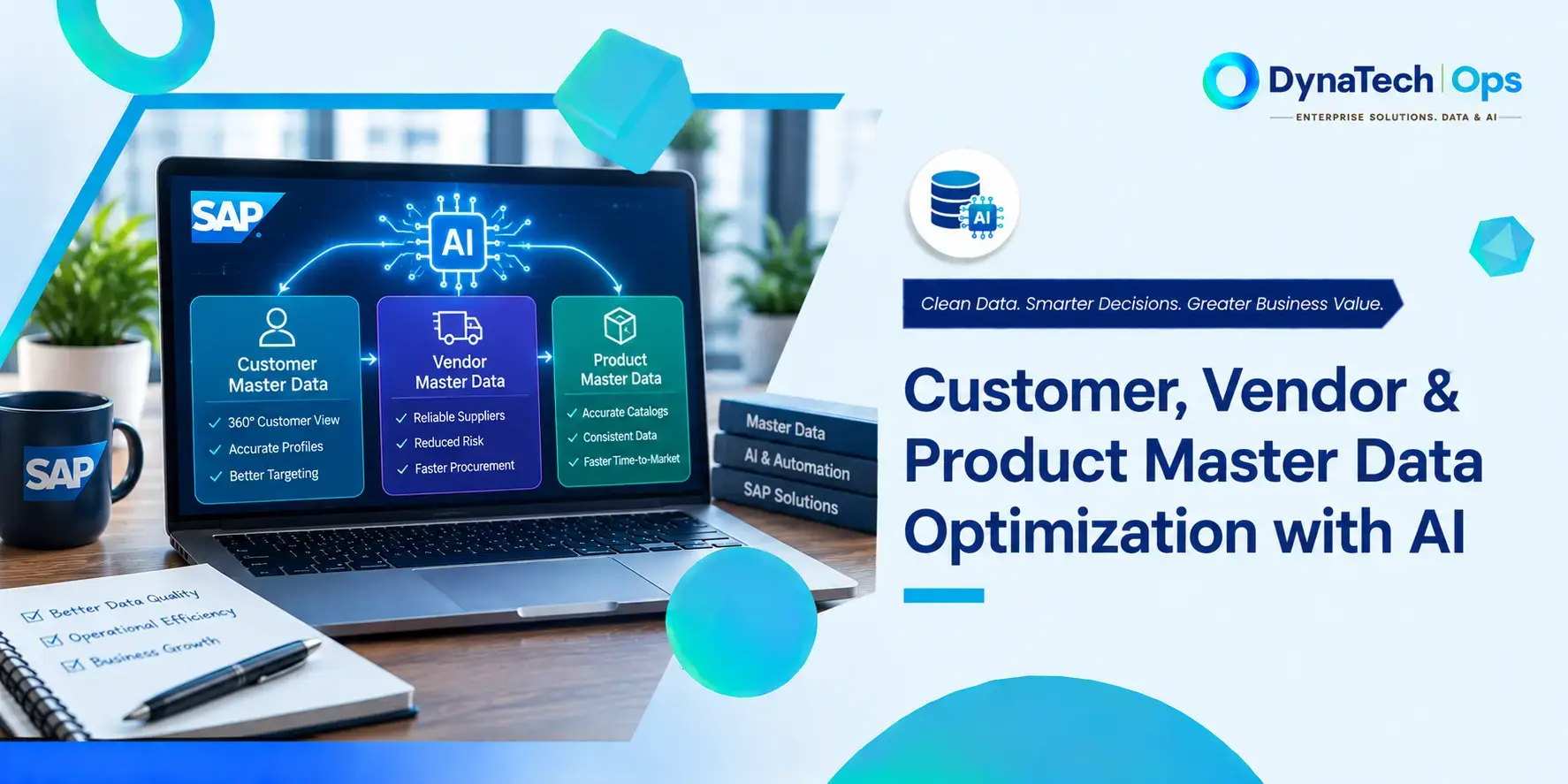
AI optimizes master data differently across customer, vendor, and product domains. Customer data benefits from real-time entity resolution, while vendor data can reveal supply-chain relationships and concentration risks. Product data can be evaluated for attribute completeness, consistency, and freshness, so it is better prepared for AI-driven search, recommendations, and commerce.
Key Takeaways
- AI master data optimization works differently across customer, vendor, and product domains, based on the type of data and business risk involved.
- Customer MDM is moving beyond periodic matching toward real-time entity resolution MDM, using techniques such as embeddings and graph-based relationships.
- For vendors, AI can connect supplier records with products, locations, and dependencies to identify risks such as vendor concentration.
- Product data needs strong attribute completeness, accuracy, consistency, and freshness to support AI-driven shopping and recommendations.
- Across all three domains, AI can process both structured records and unstructured sources such as contracts, emails, images, and transcripts.
Customer Master Data: From Batch Matching to Real-Time Resolution
Customer master data becomes difficult to manage when the same person or organization appears differently across CRM, ERP, billing, and other business systems. Traditional matching often runs on scheduled cycles, leaving duplicate or fragmented records unresolved until the next processing window.
AI is changing this with real-time entity resolution MDM. AI-powered matching can evaluate a new record as soon as it enters the system and compare it with existing master records. Current MDM research highlights techniques such as vector embeddings, graph-based models, and probabilistic matching for faster entity resolution across large datasets.
How Does Real-Time Entity Resolution Work?
Instead of relying only on exact field matches, AI can evaluate multiple signals, including:
- Name, address, email, and phone variations
- Existing customer identifiers
- Similarity between records using vector representations
- Relationships between customers, accounts, and organizations
- Historical patterns and matching confidence
The system can then classify a record as a likely match, a new entity, or a case requiring human review.
This reduces the gap between when customer data enters a system and when its identity is understood across the master-data environment.
Why Is This Important for SAP-Centric MDM?
The technical shift is not simply about processing data faster. It changes when identity resolution takes place.
AI can support continuous matching while established MDM governance processes continue to handle approvals, exceptions, policies, and stewardship. This creates a more responsive approach to customer data without removing the controls required for governed master data.
For organizations with complex SAP landscapes, the practical benefits can include:
- Earlier detection of duplicate customer records
- A more consistent customer view across systems
- Less manual investigation of routine matches
- Faster identification of relationships between customer entities
- Better-quality data for downstream analytics and processes
For regulated industries, faster visibility into customer relationships can also support requirements that information be understood across business lines.
The key shift is simple: instead of waiting for the next batch cycle to resolve a customer's record, AI can help assess and resolve that identity much closer to the point where the data enters the system.
Vendor Master Data: Where AI’s Real Value Is Cross-Domain, Not Isolated
Cleaning duplicate vendor records and standardizing supplier information are important parts of vendor master data management. However, AI delivers more value when vendor data connects with other business domains rather than being treated as an isolated dataset.
How Can AI Connect Vendor and Product Data?
AI can use knowledge graphs and relationship-based analysis to connect vendors with products, materials, business units, locations, and other master-data entities. This makes it possible to identify relationships that may not be visible when you review each dataset separately.
For example, an AI system can help answer questions such as:
- Which products depend heavily on a single vendor?
- Which business units rely on the same supplier?
- Where are supplier dependencies concentrated by product or region?
- Which vendors have relationships with critical products or materials?
Apptad highlights this cross-domain capability as a key development in AI-driven MDM , particularly where knowledge graphs can connect entities and uncover relationships across datasets.
Why Does This Matter for Vendor Risk?
This changes vendor master data optimization from a basic data-cleaning exercise into a broader risk-management capability.
A clean vendor record tells an organization who the supplier is. Connected master data can provide a much deeper view of where that supplier matters and what could be affected if the relationship is disrupted.
This is where vendor concentration risk AI can become particularly useful. By analyzing vendor and product relationships together, AI can help identify dependencies that may otherwise remain hidden across separate systems.
The result is not simply better for vendor data. It is a more connected view of supplier exposure, helping procurement, supply-chain, and data teams identify concentration risks earlier and make better-informed decisions.
Product Master Data: What AI Shopping Agents Actually Require
Product data needs to be done more than describe what a product is. AI-driven shopping experiences depend on structured, complete, and current information to understand whether a product matches a customer's specific requirements.
Which Product Data Matters Most for AI Recommendations?
AI systems can evaluate product information such as:
- Product title, description, brand, and category
- Size, color, material, weight, and dimensions
- Compatibility and technical specifications
- Availability, pricing, and shipping information
- Certifications, care instructions, and usage details
- Product images and supporting content
Industry guidance on AI-ready commerce also groups product information into different layers, including core master data, dynamic data such as availability and pricing, outcome data, and organizational information. Together, these provide the context an AI agent needs to discover and recommend products.
How Can Businesses Measure Product Data Quality?
This is where an AI product data quality score can become a practical way to prioritize improvements. Merchant Center guidance and industry analysis commonly assess factors such as attribute completeness, accuracy between feed and website data, freshness, errors, and the richness of available product information.
One practical approach is to avoid trying to perfect an entire catalogue at once. Start with the products that have the highest commercial value.
For example, teams can:
- Identify their top-selling products.
- Audit attribute completeness for these products.
- Prioritize missing specifications, pricing, availability, and image issues.
- Target 95%+ attribute completion for this priority group.
- Expand the same process to the wider catalogue.
The source recommends targeting 95%+ completion for the top revenue-driving products rather than attempting to optimize every SKU simultaneously.
This approach makes product master data optimization more measurable. Instead of simply asking whether the catalogue is “clean”, teams can identify which attributes are missing, which products need attention first, and how prepared the data is for AI-driven discovery and recommendations.
How These Domains Map to an SAP Landscape
Customer, vendor, and product master data can appear across different parts of an SAP landscape. Understanding where these domains are created, maintained, and consumed helps identify where AI-driven optimization can add value.
Customer
In SAP environments, customer information may be represented through Business Partner records and connected with customer-facing processes across sales and service.
AI-driven optimization can help identify duplicate or inconsistent records and connect customer information with relevant business context, such as:
- Business Partner and customer records
- CRM and customer-facing systems
- Sales and service processes
- Customer relationships and organizational structures
This can give teams a more consistent view of customers across the systems involved in the customer lifecycle.
Vendor and Supplier
Supplier information can also be managed through Business Partner records and connected to procurement and supply chain processes.
AI can help analyze supplier information alongside other master-data domains to identify dependencies and potential risks, including:
- Business Partner and supplier records
- Procurement processes
- Supplier and material relationships
- Business units and locations
- Critical supplier dependencies
Connecting these relationships can help organizations move beyond basic vendor-data cleansing towards a broader view of supplier exposure.
Product and Material
Product-related information in SAP can include material master records, product information, classifications, and other attributes used across business processes.
AI-driven optimisation can support areas such as:
- Material master data
- Product master information
- Product classification
- Product attributes and specifications
- Completeness and consistency checks
For organizations using product data across sales, supply chain, commerce, or analytics, improving these attributes can help provide more reliable information to downstream applications and AI use cases.
The exact terminology, data objects, and capabilities vary by SAP product, version, deployment model, and surrounding technology landscape. Organizations should therefore validate the relevant SAP products and scenarios before defining an AI MDM architecture.
The important point is that AI optimization should be connected to the way master data actually flows through the SAP landscape. This makes it easier to identify where data-quality issues occur, which processes depend on the data, and where AI-assisted capabilities can provide practical value.
The Cross-Domain Payoff: Why These Three Don’t Optimize in Isolation
Customer, vendor, and product master data are often managed as separate initiatives. However, some of the most valuable AI use cases emerge when these domains connect.
For example, understanding which high-value customers purchase products that depend on suppliers in geopolitically sensitive regions requires customer, product, and vendor data to work together. Managing each dataset separately would make this relationship difficult to identify.
This makes cross-domain intelligence a key part of AI master data optimization. Instead of asking whether each individual domain is clean, organizations can ask what new business insights become possible when these domains are connected.
Where Should Businesses Start?
A practical starting point is to focus on one high-value AI use case within each domain rather than trying to optimize everything at once.
| Domain | Real AI Technique | Practical First Step |
| Customer | Real-time streaming entity resolution | Identify where delayed matching creates compliance, regulatory, or customer-visibility gaps. |
| Vendor | Cross-domain concentration risk analysis | Map vendor dependencies against critical product lines instead of focusing only on duplicate vendor records. |
| Product | Attribute completeness scoring for AI discovery | Prioritize top-selling products and work towards 95%+ attribute completion before expanding across the catalogue. |
The broader opportunity is to connect these initiatives over time. Customer insights can inform product demand analysis, product data can expose supplier dependencies, and vendor relationships can add context to customer and product risk.
That is where AI-driven MDM moves beyond data cleansing. The value comes not only from improving individual master records, but from making relationships between them visible and actionable.
Frequently Asked Questions
1. What Is Real-Time Entity Resolution in Master Data Management?
Real-time entity resolution uses AI to assess and match new records as they enter a system, rather than waiting for a scheduled batch process. It can compare names, identifiers, addresses, relationships, and other signals to determine whether a record matches an existing master entity.
2. Why Does Vendor Master Data Quality Matter for Supply Chain Risk?
Vendor data becomes more valuable when it is connected to products, locations, business units, and other master data. This allows AI to identify supplier dependencies and concentration risks that may remain hidden when vendor records are managed on their own.
3. What Product Data Attributes Matter Most for AI Shopping Agents?
AI shopping agents need complete and reliable product information, including titles, descriptions, categories, specifications, pricing, availability, images, and compatibility details. The priority depends on the product, but missing or inconsistent attributes can make it harder for AI systems to understand and recommend it.
4. Should Customer, Vendor, and Product Master Data Be Managed Together or Separately?
Each domain still needs its own governance rules and data-quality processes, but they should not remain disconnected. Connecting customer, vendor, and product data lets AI identify relationships and risks that a single domain can't see.
Related Terms
- AI MDM for SAP – Understand how AI is being applied to master data management across SAP environments, including data quality, entity resolution, and automation.
- SAP MDG vs. AI-Driven MDM – Compare traditional SAP master data governance with AI-driven approaches and understand how real-time capabilities are changing MDM.
- SAP Data, Analytics & AI Services – Explore DynaTechOps’ approach to SAP data, analytics, and AI initiatives, including practical ways to address complex master data challenges.
Start Optimizing Your Master Data with AI
Ready to apply AI to your specific customer, vendor, or product master data challenges? Talk to DynaTechOps about where to start.