.png)


.svg "DynaTechOps")
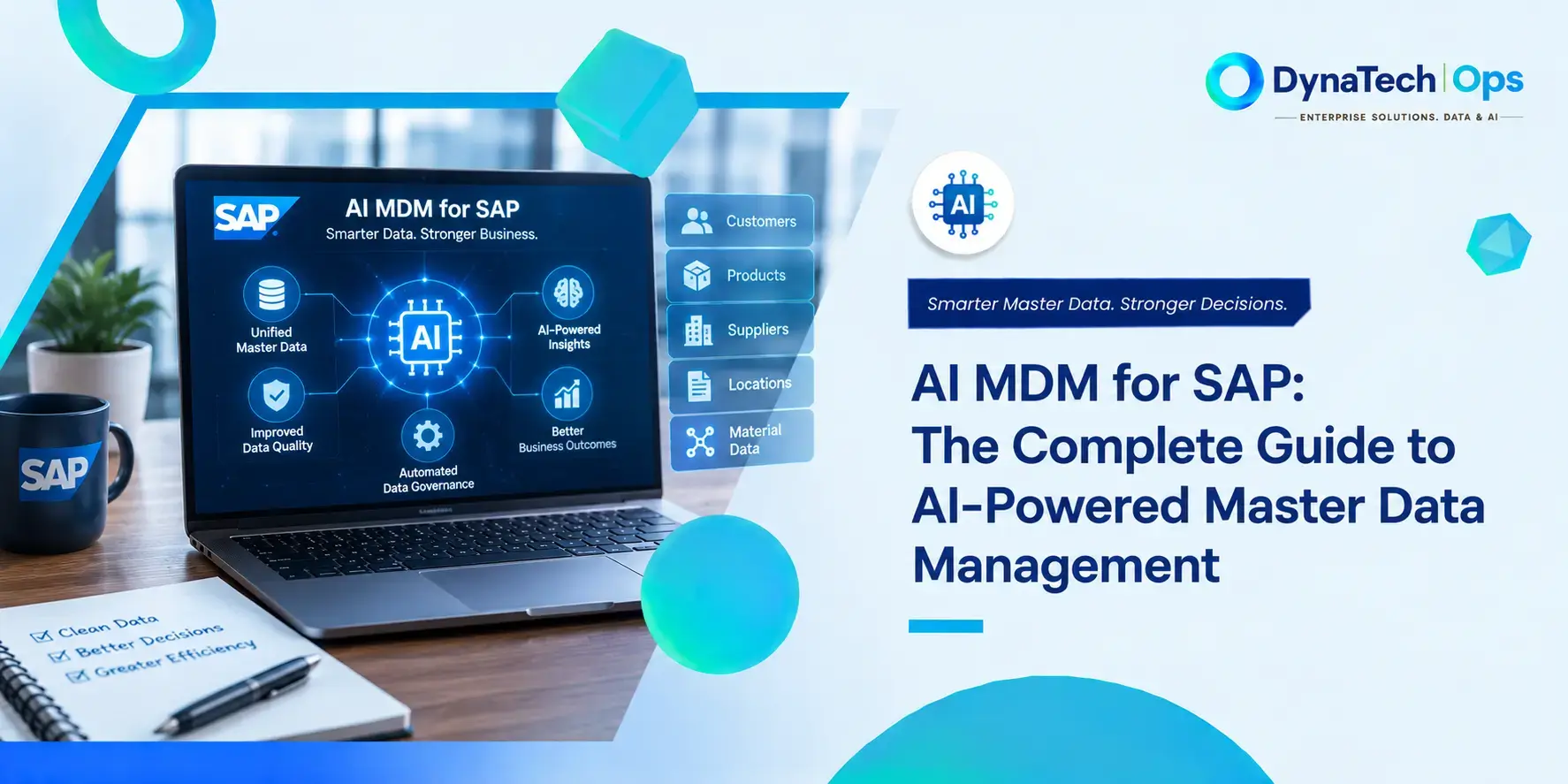
AI MDM for SAP uses artificial intelligence to clean, validate, enrich, and maintain master data, including customer, vendor, and product records. Newer agentic approaches can go beyond identifying data issues by investigating discrepancies, retrieving missing information, and taking corrective actions within defined governance controls.
Key Takeaways
- The master data management market size in 2026 is estimated at roughly $20–28 billion, depending on the research firm, with strong growth expected.
- AI is becoming a key driver of MDM as businesses need cleaner, trusted data for analytics, automation, and AI applications.
- AI-driven MDM can improve ROI, but strong data quality and governance remain essential.
- SAP landscapes are moving towards more AI-assisted data management and automation.
- This guide covers four key areas: SAP MDG vs. AI-driven MDM, AI-based master data optimization, SAP + Microsoft Fabric architecture, and data quality and governance.
Why AI MDM Is a Genuine Market Shift, Not Just a Buzzword
The MDM market growth shows organizations are investing heavily in better ways to manage critical business data. Estimates vary by research firm, but both recent reports place the master data management market size in 2026 at around $22 billion. Mordor Intelligence estimates $21.63 billion in 2026, growing to $50.85 billion by 2031 at an 18.66% CAGR. Coherent Market Insights estimates $22 billion in 2026 and $63 billion by 2033.
The key point isn't the exact market size but its direction. AI is increasingly integrated into MDM platforms for matching, classification, anomaly detection, enrichment, and governance. Coherent Market Insights notes recent vendor developments with Profisee, Stibo Systems, Informatica, and Snowflake, indicating AI-enabled MDM is progressing from emerging to practical enterprise use.
This shift matters for SAP because master data covers core processes like customer management, procurement, finance, supply chain, and product operations. As AI and automation are added, inconsistent or incomplete data can limit results. Mordor Intelligence notes high-quality data is vital for generative AI, analytics, and automation, driving MDM market growth.
AI MDM isn't just AI in addition to existing data platforms; it's about creating a responsive way to identify data issues, support stewardship, and make trusted master data available for automation. Market activity and investments show this is a growing enterprise priority, not just a trend.
The Real ROI Case for AI-Driven Master Data
The AI master data management ROI depends heavily on the quality of the data being managed. McKinsey research cited by Verdantis shows that AI-driven inventory management can reduce inventory levels by 20–30% and procurement spending by 5–15%. However, these results depend on having reliable material data for AI systems to work with.
The same source cites McKinsey research showing that predictive maintenance programmes with upfront data governance can deliver 1.8x more ROI than programmes that skip the master data foundation. This highlights an important point: AI does not remove the need for MDM. It makes the quality of the underlying data even more important.
The ROI case can therefore be viewed across a few areas:
- Lower inventory costs: Better data helps identify duplicates, improve stock decisions, and cut unnecessary inventory.
- Procurement savings: Standardized, enriched material data enhances supplier consolidation and purchasing.
- Maintenance efficiency: Reliable equipment and spare parts data can enhance predictive maintenance and minimize unnecessary downtime.
- Better AI outcomes: Clean, governed master data provides AI models and workflows with a reliable foundation.
The key caveat is simple: AI ROI is only as strong as the data behind it. Poorly governed master data can limit the value of predictive analytics, automation, and AI initiatives. That makes MDM a foundation for AI adoption, rather than a separate data-management exercise.
What This Actually Means for SAP Landscapes
SAP environments hold some of an organization's most important master data, including customer, vendor, material, and financial records. When this data is inconsistent or incomplete, the impact can spread across procurement, finance, supply chain, sales, and reporting.
AI-powered MDM can help SAP teams identify data-quality issues earlier, reduce repetitive manual work, and maintain more consistent records across business processes. The focus is not simply on automating data tasks, but on creating a stronger data foundation for analytics, automation, and AI initiatives.
For a deeper explanation of AI MDM for SAP, including agentic MDM, human-in-the-loop governance, practical AI-agent tasks and the current AI capabilities of SAP MDG, refer to the AI MDM for SAP glossary.
What's Coming Next in This Series
This guide is the starting point for a focused AI MDM for SAP content series. The upcoming articles will explore specific challenges and use cases in greater depth:
- SAP Master Data Governance vs. AI-Driven MDM: What's the Difference? A clear comparison of SAP’s native governance approach and dedicated AI-driven MDM platforms.
- Customer, Vendor & Product Master Data Optimization with AI: A practical look at how AI can improve the quality and management of customer, vendor and product data.
- SAP + Microsoft Fabric + MDM: A Unified Data Quality Architecture: Explores how master data quality fits into a broader SAP and Microsoft Fabric data strategy.
- Data Quality & Governance in SAP Landscapes: A Practical Guide: A practical guide to improving data quality and governance across SAP environments, without focusing on any single AI platform.
As each article is published, add its live link here, turning this section into an updated navigation point for the entire AI MDM for SAP content cluster.
Frequently Asked Questions
1 .How big is the AI-driven master data management market?
The master data management market is projected at $20–28 billion in 2026, varying by source. Mordor Intelligence estimates it at $21.63 billion with an 18.66% CAGR through 2031. AI drives demand for improved data quality and management.
2. Does SAP's own Master Data Governance tool include AI capabilities?
Yes. SAP Master Data Governance (MDG) includes AI-assisted features, governance, validation, and data-quality functions. Capabilities differ by SAP product, edition, and deployment, so organizations should assess their SAP landscape before assuming specific AI features are available.
3. What ROI can I expect from investing in AI-driven master data quality?
ROI varies by use of case, data quality, and implementation. McKinsey research cited by Verdantis reports 20–30% lower inventory levels and 5–15% procurement savings with certain AI applications, while predictive maintenance programmes with upfront data governance achieved 1.8x more ROI than those without a master data foundation.
4. Do I need to clean master data before adopting AI more broadly?
Clean, governed master data isn't always essential to start AI projects but is crucial for scaling reliably. Poor-quality customer, vendor, material, or product data can diminish AI accuracy and usefulness. Improving data alongside AI adoption ensures more consistent results.
Related Terms
- AI MDM for SAP: Explore the core concepts behind AI-powered master data management, including agentic MDM, governance and AI capabilities in SAP environments.
- SAP + Microsoft Fabric & Power BI: Understand how master data quality fits into a broader SAP, Microsoft Fabric and analytics strategy.
- SAP Data, Analytics & AI Services: Explore how DynaTechOps supports SAP data, analytics and AI initiatives.
Build a Stronger Data Foundation for AI
Curious how AI-driven master data management could work in your SAP landscape? Talk to DynaTechOps about your data quality strategy and explore practical ways to build a stronger foundation for AI.