.png)


.svg "DynaTechOps")
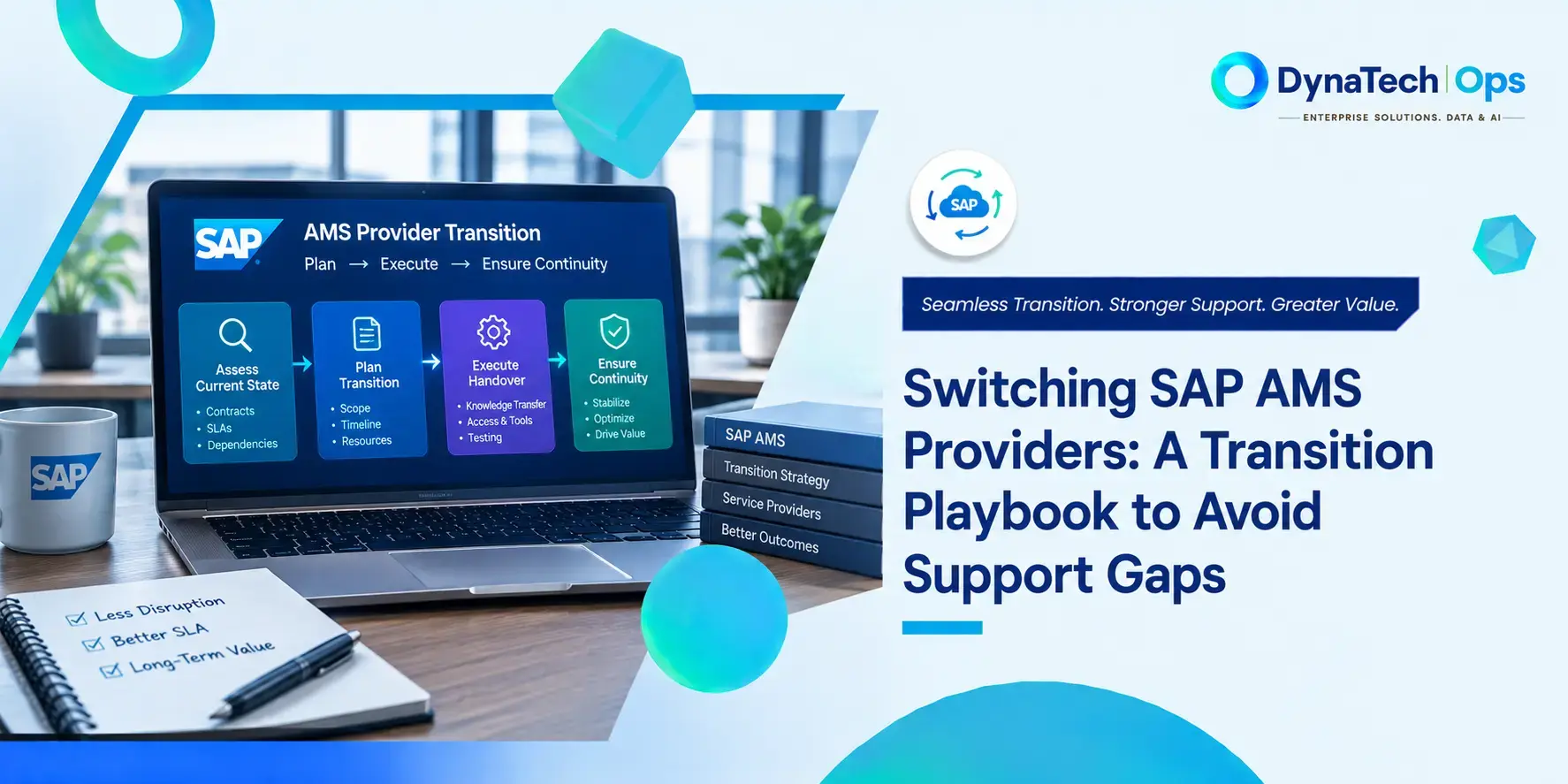
Key Takeaways
- S/4HANA transformations, changing business needs, and support issues are prompting more organizations to review their SAP AMS providers.
- The main transition risk is usually a coverage gap, not an SAP system outage.
- A structured handover needs clear ownership, access, documentation, knowledge transfer, shadowing, and escalation paths.
- Switching SAP support provider costs vary based on the SAP landscape, contract, knowledge transfer, and team overlap.
- A clear transition plan can make switching less risky than continuing with an underperforming provider.
- Recurring SLA misses, slow resolution, limited expertise, and weak communication can signal it's time to switch SAP AMS providers.
Changing an SAP AMS provider appears risky, especially when the business depends on it for support. Unhappy organizations hesitate, fearing disruptions in transferring system knowledge, access, processes, incidents, customizations, integrations, and business context.
This creates a common pattern where providers lack SLAs, are slow to resolve issues, rely on a few experts, or offer little proactive support. Organizations keep this setup because switching seems more complicated, which normalizes the cost of poor support.
A good SAP AMS transition plan can make all the difference. The goal is not to bring in another provider on a specific date and hand over the reins. The goal is to ensure a smooth ownership transition, retain operational understanding, and give the new support provider all the information needed to support your SAP landscape.
The key question isn't whether switching to SAP AMS providers is risky—some risk is unavoidable. The real question is whether you can identify, manage, and reduce that risk beforehand. With proper preparation, governance, and an SAP support handover checklist, organizations can transition smoothly without support gaps
Why More Organizations Are Switching AMS Providers Right Now
Switching SAP AMS providers isn't just for major support failures; more businesses reevaluate their partnerships as their SAP setups, models, and tech plans evolve.
According to The Config Team, February 2026, 2026, and 2027 are expected to see a higher volume of organizations moving to new AMS partners than at any time in recent years. One major factor behind this trend is the growing number of S/4HANA transformation and upgrade programmes.
Many organizations use an S/4HANA programme to review support models, as providers suited for older SAP environments may lack the expertise, transformation experience, governance, or delivery approach for the next phase.
S/4HANA Programmes Are Triggering Wider AMS Reviews
An S/4HANA upgrade can reveal hidden gaps in supposedly stable legacy systems. Organizations may doubt if their AMS partner can support the future SAP roadmap, not just maintaining the current landscape.The review may cover:
- S/4HANA functional and technical expertise
- Integration and extension support
- Change and release management
- SAP security and governance
- Automation and proactive monitoring
- Capacity to support future transformation programmes
- Commercial flexibility as the SAP environment changes
This doesn't mean replacing the current provider, but a major SAP transformation offers an opportunity to reevaluate the partnership.
Not Every Provider Change Is Linked to S/4HANA
Another important group of organizations is switching SAP support providers without undertaking an S/4HANA migration.
Their reasons are often operational: persistent incidents, inconsistent service, unpredictable costs, limited SAP resources, or poor communication can make current arrangements hard to justify.
Some organizations are also looking for:
- More predictable and transparent pricing
- Stronger SLA management
- Better functional and technical coverage
- Faster incident resolution
- More proactive problem management
- Greater flexibility in scaling support
- Better governance and reporting
In these situations, the decision to switch is not about chasing a new technology model but about finding an AMS partner that offers stable support for the existing SAP environment.
That distinction matters. A provider's change isn't limited to major SAP transformations; it can also respond to an AMS relationship that no longer provides the required service.
As a result, organizations should not view signs to switch SAP AMS providers as evidence of a failed SAP strategy. Sometimes, changing the support partner is simply a way to align the operating model with the organization's current requirements.
Why “Downtime” Really Means Coverage Gap, Not System Outage
When organizations say they can switch SAP AMS providers “without downtime”, they usually mean the SAP system can keep running during the transition, not necessarily that servers stay uninterrupted.
The more important risk is a continuity gap in support.
During handover, the organization must ensure no critical tickets lack owners, issues lose context, or the incoming team lacks client SAP knowledge. Access to problems, incomplete docs, unclear escalation, or missing process info can cause disruptions even if SAP is available.
A safe transition therefore focuses on maintaining support coverage and operational continuity, not simply avoiding a technical outage.
This distinction dramatically changes the transition approach. You can't let go of the old provider one day and pick up a new one the next. Transition must encompass handover, sharing, management, and transfer of documentation and ownership.
What a Structured Transition Actually Includes
A successful SAP AMS transition is more than a technical handover. It is a controlled programme involving business stakeholders, service management, technical teams, and both outgoing and incoming providers.
1. A Joint Transition Project Plan
The first step is to establish a project plan that covers both sides of the transition.
It should define:
- Transition milestones and ownership
- Responsibilities of the outgoing and incoming providers
- Knowledge-transfer sessions
- Access and connectivity requirements
- Open incidents, problems, requests, and changes
- Testing and validation activities
- Cutover and go-live criteria
- Escalation routes during the transition
This gives all parties a shared view of what needs to happen before supporting responsibility moves.
2. Complete Access, Documentation and Knowledge Transfer
Technical documentation alone is not enough. The incoming team needs to understand how the organization actually uses SAP.
Knowledge transfer should cover:
- SAP architecture and system landscape
- Custom developments and integrations
- Business-critical processes
- Interfaces and dependencies
- Recurring incidents and known problems
- Security roles and access requirements
- Monitoring and operational procedures
- Existing enhancement and change backlogs
The business context behind a configuration is as important as the configuration itself. Support consultants must understand not only the technical process but also the reason for a business rule, workflow, or customization.
3. Define Operating Procedures Before Handover
A SAP support handover checklist should include the operating rules that the new provider will follow from day one.
This can include:
- Rules of engagement
- Ticket categorization and routing
- Priority and SLA definitions
- Escalation paths
- Change management procedures
- Change Advisory Board (CAB) processes
- SAP transport windows
- Release and deployment procedures
- Major incident management
- Communication and reporting requirements
Transport windows are crucial in SAP environments for coordinating changes with business operations, testing, release schedules, and systems. Documenting procedures beforehand prevent confusion when the team takes over.
4. Establish a Governance and Review Cadence
The transition should also define what happens after the initial handover.
An agreed cadence can include:
| Review | Typical focus |
| Weekly | Transition progress, open risks, knowledge-transfer status |
| Monthly | SLA performance, ticket trends, incidents and service quality |
| Quarterly | Service improvement, capacity, roadmap alignment and recurring issues |
| Annual | Contract, support model and long-term SAP strategy review |
This prevents the transition from becoming a one-time event. It creates a governance structure to measure whether the new AMS arrangement is delivering the expected results.
5. Agree Success Criteria Before Go-Live
The final handover must not have to rely on an ambiguous "the new team is ready" decision. Both parties must set clear, quantifiable acceptance criteria prior to handing over to the new provider. Knowledge of transfer, access, documentation, ticket ownership, escalation, reporting, and risks.
A formal acceptance sign-off confirms that transition requirements are met and clarifies accountability if issues occur after go-live.
The Real Cost of Switching and When It Pays Back
One major concern when switching SAP support providers is the transition cost, especially if both teams overlap during handover.
According to The Config Team, a focused transition may require an upfront investment of one to two months of AMS commitment, with the cost potentially recovered within six months through better stability, efficiency, and governance.
Actual SAP AMS provider switching costs vary based on the SAP landscape, contract terms, knowledge transfer, and transition duration. The cost should also be weighed against the ongoing impact of incidents, delays, rework, and poor governance with the existing provider.
Value-Add Opportunities During Transition
A provider in transition does not have to be limited to transferring existing responsibilities. It can also be a useful opportunity to review the SAP environment and identify issues the previous support model may not have addressed.
The Config Team highlights additional services that can be incorporated during an AMS transition, including vulnerability assessments, SAP EarlyWatch Alert reviews, and performance and sizing assessments. These activities can help identify potential risks while the new provider is building its understanding of the environment.
Depending on the SAP landscape, the transition period can therefore be used to:
- Review security and vulnerability risks
- Analyze SAP EarlyWatch Alert findings
- Assess system performance and capacity
- Review infrastructure and sizing
- Identify recurring incidents and root causes
- Examine areas suitable for automation
- Clean up outdated documentation and support procedures
- Reassess monitoring and escalation processes
This approach shifts the transition's purpose from maintaining the current support model to establishing a stronger baseline for future SAP operations.
A Realistic Transition Timeline
The exact duration depends on the complexity of the SAP landscape, but a phased approach makes the transition easier to control. A typical SAP AMS transition plan can follow four broad stages:
| Phase | Timeline | Main Activities |
| Discovery & Knowledge Transfer | Weeks 1–2 | Landscape discovery, documentation review, access setup, business-process knowledge transfer and review of open tickets |
| Parallel Run / Shadow Support | Weeks 3–4 | Incoming team observes and supports incidents alongside the existing provider, with knowledge gaps identified and addressed |
| Full Handover & Escalation | Week 5+ | Incoming provider assumes primary responsibility, with defined escalation routes and enhanced monitoring |
| Post-Transition Review | 30–60 days | Review SLAs, ticket trends, unresolved issues, stakeholder feedback, risks and service-improvement opportunities |
Don't treat these stages as strict deadlines; a complex SAP environment may need longer knowledge of transfer or support. Prioritize readiness over quick transition.
Signs It’s Time to Switch, Not Just Complain
Not every AMS issue requires a provider to change. However, recurring problems that remain unresolved despite reviews and corrective actions may indicate it is time to reconsider the partnership.
-
Recurring SLA Misses
Occasional SLA misses can happen, but repeated delays without a clear improvement plan may point to gaps in resources, processes, or expertise.
-
High Consultant Turnover
Frequent team changes force internal teams to repeatedly explain SAP configurations, customizations, and business processes, leading to slower resolution and knowledge gaps.
-
No Technical Pushback
A good AMS partner should challenge requests that create unnecessary risk, technical debt, or security concerns instead of simply agreeing to everything.
-
Opaque Pricing
Unexplained charges, frequent scope of changes, or routine tasks being treated as additional work can indicate the need for a clearer commercial model.
Together, these are common signs to switch SAP AMS providers. The decision should be based on recurring patterns rather than a single service issue.
Frequently Asked Questions
1. How long does it take to switch SAP AMS providers?
A typical transition starts with discovery and knowledge transfer in weeks one and two, then parallel support in weeks three and four, and full handover by week five. Complex SAP systems may take longer, depending on systems, integrations, processes, and transfer needs.
2. Will there be a gap in support coverage during the transition?
There should be no planned gap in support coverage. A structured transition uses overlapping teams, clear ticket ownership, documented escalation paths, and defined handover criteria to maintain continuity as responsibility moves from the outgoing to the incoming provider.
3. How much does switching SAP AMS providers typically cost?
A focused transition may require an upfront investment of one to two months of AMS commitment, as per The Config Team. The cost of switching SAP AMS providers varies depending on the SAP landscape, contract terms, transition duration, knowledge transfer needs, and the need for parallel support.
4. Can a transition include a system health check, not just a handover?
An AMS transition includes vulnerability assessments, SAP EarlyWatch Alert reviews, performance and sizing reviews to identify risks and improvement opportunities, not just inheriting the support model.
Related Terms
- SAP AMS: The Complete Guide – Covers SAP Application Management Services, including provider selection and transition considerations.
- SAP AMS Glossary – Explains key SAP AMS terms and concepts.
- SAP Managed Services (AMS) – Provides an overview of DynaTechOps’ SAP support and managed services.
A Structured SAP AMS Transition with DynaTechOps
Considering a switch? DynaTechOps supports knowledge transfer to ensure seamless support, clear ownership, and formal signoff. It helps organizations move to a new SAP AMS model without coverage gaps.