.png)


.svg "DynaTechOps")
Key Takeaways
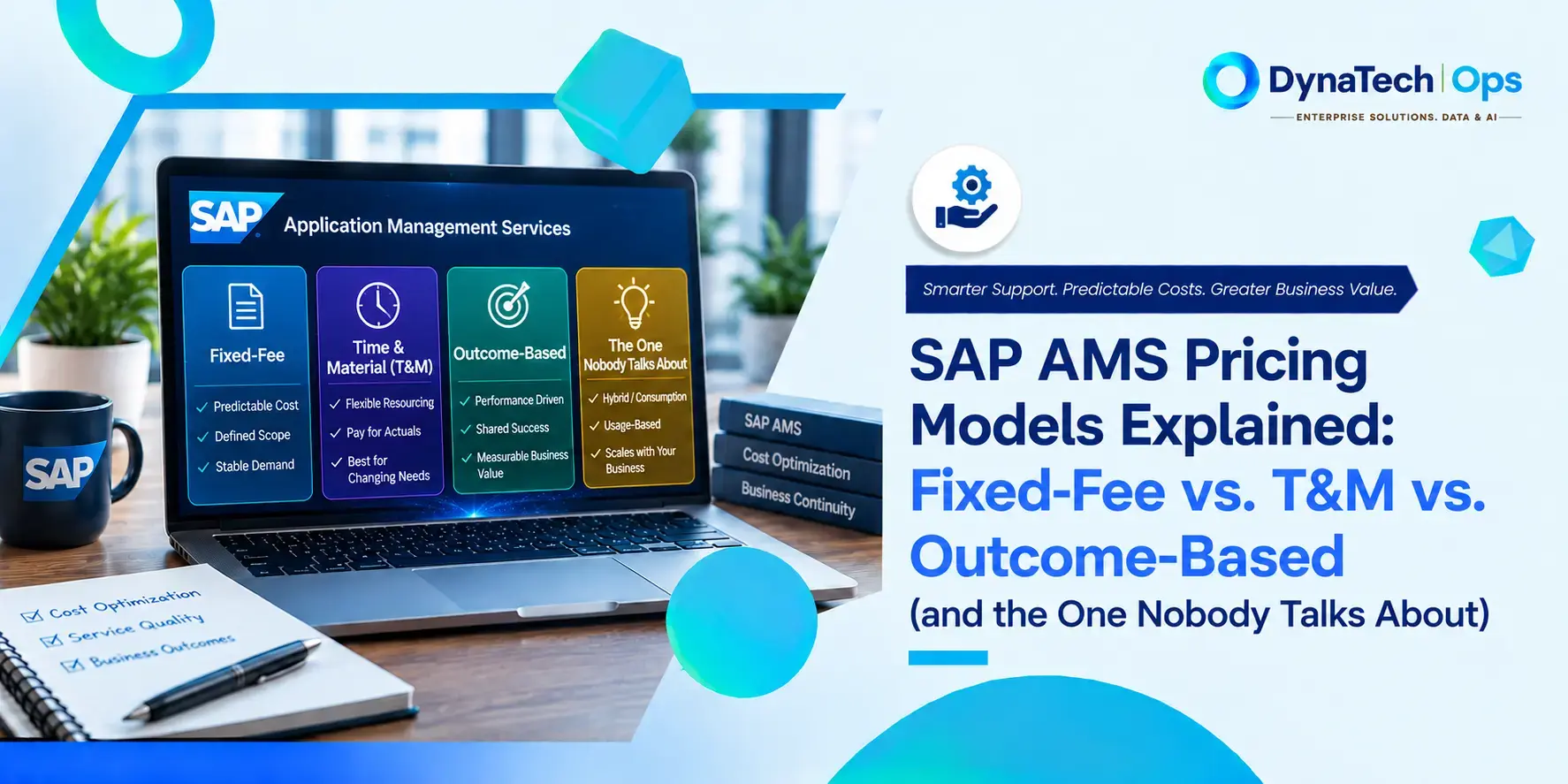
- Fixed-fee, Time & Materials (T&M), and outcome-based pricing are the three commonly discussed SAP AMS pricing models. In practice, a fourth approach, the hybrid model can combine fixed and variable billing to provide greater flexibility.
- Fixed-fee pricing provides greater budget predictability, but providers may include a risk buffer to account for uncertain workloads, scope of changes, and unexpected support requirements.
- T&M pricing gives organizations more flexibility because they pay for the resources or hours used. However, costs can increase when demand rises. A Not-to-Exceed (NTE) clause can establish a maximum spending limit under agreed conditions.
- SAP AMS outcome-based pricing links fees to defined service results or performance measures, such as uptime, incident reduction, or agreed service-level targets, rather than focusing only on the effort involved.
- An SAP AMS hybrid pricing model combines different billing structures, such as a fixed fee for predictable support and variable pricing for additional services. This approach can balance cost control with the flexibility needed for changing SAP environments.
Introduction
Choosing an SAP Application Management Services (AMS) provider is not just about comparing service capabilities. The pricing model in the contract can directly affect budget control, flexibility, risk, and the overall value of the engagement.
This becomes particularly important because SAP support requirements can change significantly across an environment's lifecycle. Routine ECC or S/4HANA support may have relatively predictable workloads, while SAP upgrades, integration projects, quarterly releases, and post-go-live hypercare can create temporary increases in support demand.
Most discussions about SAP AMS pricing stop at three options: fixed-fee, Time & Materials (T&M), and outcome-based pricing. These models matter, but they do not tell the whole story. Many AMS arrangements can combine fixed and variable pricing depending on the service, workload, or expected outcome.
Current public information from providers such as Protera and Accely does not provide a structured comparison of their SAP AMS pricing approaches. This guide therefore focuses on how the major pricing structures work, where each model fits, and why the often-overlooked hybrid approach can be relevant to organizations managing changing SAP environments.
Fixed-Fee Pricing - What You're Really Paying For
Fixed-fee pricing offers a predictable recurring charge for a set of SAP AMS support scope, covering ticket volume, modules, hours, response times, and SLA tiers, if the service stays within scope. When comparing SAP AMS fixed fee vs time and materials, the main difference is how workload risk and cost uncertainty are shared between the client and provider.
Providers include a 15%-30% risk buffer in the fixed fee for 2026 industry pricing to compensate for unpredictable ticket volumes, balancing support demand risks with cost certainty for clients.
This buffer is not necessarily a red flag. It is a normal part of pricing for a provider that is taking on workload risk. The important point is to understand what assumptions the fixed fee is based on and what happens when actual demand exceeds them.
Time & Materials (T&M) - Real Flexibility, Real Risk
Time & Materials (T&M) pricing charges the client based on the actual hours worked and resources used. The client and AMS provider agree on rates for different roles or skill levels, while the final cost depends on the support effort required during the billing period.
The choice in SAP AMS fixed fee vs time and materials often comes down to whether the organization values predictable costs or greater flexibility.
How T&M Pricing Works
Under a T&M model, the agreement typically defines:
- Hourly or daily rates: Charges vary by SAP role, skill, or service level.
- Resources used: Billing is based on the people and effort required to deliver the service.
- Actual workload: Costs can increase or decrease depending on ticket volumes, incidents, projects, and support requirements.
- Agreed billing terms: The contract specifies how hours are recorded, approved, and invoiced.
The Main Risk: Unpredictable Costs
T&M provides flexibility when SAP support needs are difficult to predict. However, higher ticket volumes, complex incidents, or extended support requirements can quickly increase the SAP AMS cost.
This is particularly relevant during:
- Post-go-live hyper care
- Active SAP migrations
- Seasonal business peaks
- Major system changes
- Periods of unexpected support demand
Protecting the Budget with an SAP AMS not-to-exceed clause
A standard way to control this risk is an SAP AMS Not-to-Exceed clause. An NTE clause establishes a maximum amount the provider can bill for the agreed services during a defined period.
For example, an agreement could specify that T&M services cannot exceed a set monthly amount without formal approval. If expected costs go beyond that limit, the provider must obtain approval or agree to a contract change before billing above the cap.
When negotiating an NTE clause, clarify:
- The maximum spending limit
- What services are covered
- The period covered by the cap
- What happens when the limit is reached
- How additional work receives approval
T&M is often a good fit when support demand is genuinely unpredictable. With clear rates, reporting, and an NTE clause, organizations can retain the flexibility of T&M while putting stronger controls around unexpected costs.
Outcome-Based Pricing - Paying for Results, Not Hours
SAP AMS outcome-based pricing takes a different approach to traditional AMS billing. Instead of paying mainly for hours worked or a fixed scope, the client’s fees are linked to measurable service outcomes. The provider is therefore rewarded for achieving agreed performance results rather than simply delivering a set amount of effort.
How Outcome-Based Pricing Works
The contract defines specific outcomes and performance measures that determine how the provider is paid. Depending on the SAP environment, these may include:
- System uptime: Maintaining an agreed availability percentage.
- Incident reduction: Reducing recurring or high-priority incidents over an agreed period.
- Resolution time: Meeting defined targets for resolving incidents.
- Service-level performance: Achieving agreed SLA targets consistently.
- Operational improvements: Delivering measurable improvements in specific support areas.
For example, instead of charging only the number of hours spent resolving incidents, an agreement could link part of the fee to maintaining a defined uptime level or reducing repeat incidents.
Where Outcome-Based Pricing Works Best
This model generally works better for mature SAP environments where the client and provider have enough historical data to understand workload patterns and establish realistic targets.
Before choosing SAP AMS outcome-based pricing, organizations should have reliable historical data and clearly defined performance measures.
It can be suitable when:
- Historical tickets and incident data are available.
- SAP performance can be measured consistently.
- Service outcomes can be clearly defined.
- Both parties agree on reliable performance metrics.
- The provider has enough knowledge of the environment to estimate the effort and risk involved.
The Catch: It Needs Trust and Data
Outcome-based pricing is not automatically better than fixed-fee or T&M. It requires more preparation because both sides need to agree on what counts as a successful outcome, how it will be measured, and what happens when external factors affect performance.
For a brand-new AMS relationship, this can be difficult. The provider may not yet understand the client's SAP landscape, historical ticket patterns, dependencies, or operational challenges well enough to price outcomes accurately.
For this reason, outcome-based pricing is often more practical after the provider has gained sufficient knowledge of the SAP environment. Without reliable data and clear metrics, an outcome-based model can create disagreements instead of delivering the expected value.
The Hybrid Model - What Most Pricing Guides Never Mention
The hybrid model combines two or more pricing structures within the same SAP AMS contract. While most SAP AMS pricing discussions focus on fixed-fee, Time & Materials (T&M), and outcome-based pricing separately, many practical arrangements can combine these approaches based on the type of work being delivered.
This can be particularly useful for SAP environments where some support requirements are predictable while others change frequently. For example, routine ECC or S/4HANA support may be covered under a fixed fee, while additional work during an SAP upgrade, integration project, or post-go-live period may use T&M pricing.
Common Hybrid AMS Structures
There is no single way to structure a hybrid SAP AMS agreement. The combination usually depends on the client's SAP landscape, support volumes, project activity, and ability to define measurable outcomes.
Fixed + T&M
This is one of the most common hybrid structures.
The fixed component covers predictable services such as routine incident management, monitoring, standard SAP support, and an agreed volume of tickets or support hours. T&M rates then apply when the client requires support beyond the agreed baseline.
For example, an organisation running SAP S/4HANA could use a fixed monthly fee for regular application support. Additional consulting hours required during an integration project or major system change could then be billed at agreed T&M rates.
This structure provides a predictable baseline while retaining flexibility for variable demand.
Fixed + Outcome-Based
This structure combines a predictable base fee with incentives linked to defined service outcomes. It is an emerging approach for organisations that want to move beyond paying only for support effort.
The fixed portion can cover standard AMS services, while a variable component may depend on agreed measures such as service availability, incident reduction, resolution performance, or other clearly defined operational targets.
For this model to work effectively, both sides need reliable data and clearly defined measurement rules. Otherwise, disagreements can arise over whether the agreed outcome was achieved and which factors influenced the result.
Fixed + T&M + Outcome Incentives
An enterprise SAP environment may combine all three structures.
The fixed component can cover the core AMS service. T&M can apply to work that falls outside the agreed baseline, such as major enhancements, integration changes, or additional support during an SAP upgrade. Outcome-based incentives can then be attached to selected performance measures.
For example, an enterprise running a large S/4HANA landscape could have:
- A fixed monthly fee for standard AMS support.
- T&M billing for additional work during integration projects or major changes.
- An outcome-based incentive linked to agreed service-level or incident-reduction targets.
This structure allows different types of SAP work to be priced according to their level of predictability and measurability. However, it also makes contract governance more important because each component needs clearly defined rules.
Why Hybrid Pricing Fits Changing SAP Environments
SAP support demand rarely stays constant throughout the year. A stable production environment may require predictable support for several months and then experience higher demand during a major release, upgrade, migration, or integration programme.
Hypercare is another example. After an SAP implementation or major S/4HANA transition, incident volumes can temporarily increase. A purely fixed model may need to account for that additional risk, while a purely T&M model can make costs harder to forecast.
A hybrid arrangement can assign different pricing mechanisms to these different situations.
For example:
|
SAP Situation |
Potential Pricing Structure |
|
Routine ECC support |
Fixed fee |
|
Regular S/4HANA application support |
Fixed fee |
|
Post-go-live hypercare |
Fixed + T&M |
|
SAP upgrade support |
Fixed + T&M |
|
Integration project |
T&M |
|
Defined service-level improvement |
Outcome incentive |
|
Quarterly release support |
Fixed + variable component |
The exact structure should depend on the contract scope rather than applying the same billing method to every type of SAP work.
What to Define in a Hybrid SAP AMS Contract
Hybrid pricing can provide flexibility, but unclear boundaries can also create unexpected costs. Before signing, define:
- What services are included in the fixed fee.
- The number of tickets, hours, modules, or systems covered.
- Which activities trigger T&M billing.
- The agreed T&M rates for additional work.
- Which SAP projects or changes are treated separately.
- The KPIs used for any outcome-based incentives.
- How performance is measured and reported.
- Whether an NTE limit applies to variable charges.
- How scope changes and additional work are approved.
The objective is not simply to combine pricing models. It is to ensure that each part of the SAP AMS service has a clear commercial treatment.
This is why the hybrid model deserves more attention in SAP AMS pricing discussions. It can accommodate the predictable baseline of ongoing support while providing a defined mechanism for periods when the SAP environment requires additional effort or performance-based delivery.
Which Model Actually Fits Your SAP Landscape?
The right SAP AMS pricing model depends on how predictable your support workload is, how much cost certainty you need, and how easily your SAP environment can accommodate changes. The comparison below highlights the main differences between the four models.
| Model | Cost Predictability | Flexibility | Best For |
| Fixed-Fee | High | Low | Stable, predictable SAP environments |
| T&M | Low without a cap | High | Fluctuating or unpredictable support needs |
| Outcome-Based | Medium | Medium | Mature environments and results-focused clients |
| Hybrid | High for baseline | High beyond baseline | Most real-world AMS relationships |
This SAP AMS fixed fee vs time and materials comparison is useful when the main decision is between predictable billing and flexible support capacity.
The Real Risk Nobody Prices In
Choosing the right SAP AMS pricing models can improve cost control, but pricing alone does not eliminate delivery risk. Unclear scope, weak governance, and poorly defined responsibilities can create problems even when the pricing structure looks attractive.
Industry analysis citing McKinsey reports that 17% of large IT projects go so badly that they threaten the survival of the company. This highlights why organizations should look beyond the headline of SAP AMS cost when evaluating a contract.
Before choosing a model, clarify:
- Scope: What is included and excluded?
- Governance: Who reviews performance, costs, and changes?
- SLAs: How are service levels measured?
- Change control: How are additional requirements approved and priced?
A well-defined contract and strong governance can matter just as much as choosing between fixed-fee, T&M, outcome-based, or hybrid pricing.
Questions to Ask Before You Sign
Before signing an SAP AMS contract, use these questions to understand how the pricing model will work in practice:
- What is included in the “inclusive volume” under a hybrid model? Clarify the number of tickets, support hours, modules, and services covered by the fixed fee.
- What happens when the inclusive volume exceeds? Ask for the exact T&M rates and billing rules that will apply to additional work.
- Is there an SAP AMS not-to-exceed clause? Confirm the spending cap, what services it covers, and what triggers a renegotiation or formal change request.
- How are outcome-based targets measured? Define the KPIs, measurement method, reporting frequency, and who has responsibility for validating the results.
- What is outside the agreed scope? Identify enhancements, projects, specialized support, and other services that could create additional SAP AMS cost.
- How are pricing changes approved? Confirm the process for changing scope, support volumes, rates, or service levels during the contract.
Frequently Asked Questions
1. What is the most common SAP AMS pricing model?
No single pricing model applies to every SAP AMS provider, but hybrid pricing is common in real-world AMS contracts. It can combine a fixed fee for an agreed support volume with T&M billing for work beyond that baseline.
2. Is a fixed fee or T&M better for SAP AMS?
Fixed fees are generally better for stable, predictable SAP support needs, while T&M is better when workload and support requirements can change significantly. The better choice depends on the organization's workload predictability, budget controls, and required flexibility.
3. What is a Not-to-Exceed clause in an AMS contract?
An SAP AMS not-to-exceed clause sets a maximum amount the provider can bill for defined services during an agreed period without formal approval for additional spending. It can help control the cost risk associated with T&M or variable components of a hybrid contract.
4. Can SAP AMS pricing combine multiple models?
Yes, SAP AMS pricing can combine multiple models within one contract. A hybrid arrangement can use a fixed fee for routine support, T&M rates for additional work, and SAP AMS outcome-based pricing for specific measurable service results.
5. What Is the Cheapest SAP AMS Pricing Model?
There is no universally cheapest SAP AMS pricing model. T&M may cost less when support demand is low, while fixed fee or hybrid pricing may offer better value when workloads are more predictable.
6. Why Do Fixed-Fee AMS Contracts Fail?
Fixed-fee AMS contracts can fail when the scope, workload assumptions, or exclusions are unclear. Unexpected ticket volumes, SAP upgrades, or integration work can also create disputes over what the fixed fee covers.
7. How Do AMS Providers Handle Scope Creep?
AMS providers typically handle scope creeping through change requests, additional T&M charges, or revised pricing. The contract should clearly define the out-of-scope of work and the approval process for additional services.
Related Terms
Explore these resources to understand SAP AMS, its pricing details, and managed service options.
Find the Right SAP AMS Pricing Model
Unsure which SAP AMS pricing model suits your environment? Contact DynaTech Ops for a support plan based on your actual usage, not a generic service tier.